Vol 8 (2026), No 3: 244–270
DOI: 10.21248/jfml.2026.121
Note from the editors: This article is part of the Quo Vadis special issue and was therefore not subject to a peer-review process.
The material of media: a view from multimodal semiotics
A re-analysis and position paper
Abstract
‘Media’ and ‘medium’ are established key constructs for many kinds of engagements with communication, both linguistic and otherwise. And yet, a host of unresolved issues remain concerning the most effective ways to conceptualise just what ‘medial’ contributions are and how they may relate to other aspects of communication. Discussions of medium tend to span from treatments of the consequences of the diverse material substrates of communication on the one hand (‘medium as carrier’ or ‘in-between’), through to complex and dynamic institutional practices on the other (‘media as social institutions’). This cannot but leave a somewhat confused picture. In this position paper, I illustrate the role of medium within our own work on multimodal semiotics, engaging specifically with the media linguistic discussions of media and multimodality pursued in an earlier paper in jfml by Luginbühl/Schneider (2020). Within our multimodality account, the theoretical and descriptive work found most beneficial for analysis has pulled our characterisations of materiality and of media in quite different directions, opening up more theoretical space for nuanced description. I present this position briefly and then consider both how it relates to approaches to mediality more generally and how it might contribute useful complementary methods of analysis, particularly when engaging with medially complex multimodal situations.
Keywords: semiotic mode, materiality, multimodality, TV debates, method
1 Introduction
One of the reasons the notion of ‘medium’ remains a substantial point of critical debate and reflection is that it involves an intrinsic tension between materiality, on the one hand, and social institutions, on the other. In this respect, it is not unlike many other semiotically relevant terms that similarly find themselves negotiating their respective paths between the materiality of semiotic practices and those practices’ interpretation and meaning. Discussions of medium, while marking out their own particular path, have then also been complicated substantially by their entanglement with other paths navigating similar waters. The position presented here will suggest that this often occurs when discussing the notions of ‘medium’ and of ‘semiotic mode’. Both notions move between material and meaning but do so in very different ways with very different concerns. Untangling these paths allows cleaner characterisations of both that are of considerable help when pursuing analyses of complex communicative situations.
In Bateman et al. (2017), we began exploring the role of ‘medium’ from the perspective of semiotic mode. As a consequence, ‘medium’ remained somewhat peripheral to our principal concerns, leaving its formulation sketchy. In the present essay, I return to ‘medium’ more in its own right, although still applying what we have learned about semiotic modes in the meantime and their relation both to material and to interpretations. This view of medium is actively deployed for analysis in Bateman et al. (2026) and I will suggest here that such a perspective may usefully complement some of the current approaches to medium voiced in media linguistics as well.
Several of these approaches have come to emphasise more process-oriented descriptions of their phenomena, for example by focusing on media practices (Luginbühl/Schneider 2020) or the ‘work’ involved in creating and maintaining media (e.g., ‘infrastructuring’: Meiler 2017, 2019). Whether this provides sufficiently strong methodological guidance for analysis is less clear, however, particularly when moving beyond the relatively safe waters of the ‘linguistic’ where many well-established methods can be applied. The position presented here will be that the more finely articulated notion of materiality developed in our architecture for multimodality offers a tighter methodological hold on analysis across all modalities. To support this claim, the approach will be related to the discussion and examples previously pursued in jfml by Luginbühl/Schneider (2020), specifically re-examining their characterisation of media configurations in presidential debates. The discussion then parallels and deepens Wildfeuer’s (2024) similar engagement with Luginbühl and Schneider, showing how materiality and media can be productively disentangled.
The organisation of the contribution overall is as follows. First, the position of ‘medium’ within our original multimodal semiotic architecture will be briefly revisited, picking out the properties important for taking discussion further. Second, the extension and development of our current view of ‘media’ within the overall multimodal semiotic framework will be set out. And third, I turn to Luginbühl/Schneider’s (2020) complex media situation of televised presidential debates. A brief review and outlook concludes.
2 Take 1: Media and semiotic modes
In the multimodal semiotic architecture developed in Bateman et al. (2017), semiotic modes are assigned a central role for driving practical analysis. To achieve this, it was necessary to formulate definitions of the semiotic mode construct far tighter than those previously found in the literature (cf. Bateman et al. 2020). Consequently, each semiotic mode is now handled as a set of interlinked semiotic resources bundled in a very specific way and for a very specific purpose. That purpose is to provide resources and practices that allow communities of sign-users to synchronise their collective engagements with the world. That is: by shaping externalised and perceptible material regularities accessible to members of a community in particular conventionalised ways, correspondingly aligned and conventionalised ‘interpretations’ (including, following Peirce, courses of action and other forms of response) are supported.
In line with many current proposals for communication, this view is already strongly performance oriented, inheriting from its Hallidayan systemic functional linguistic origins (cf. Halliday 1978) the essential inseparability of structure and process, of synoptic and dynamic, of potential and instance. All resources defined bind these perspectives. Semiotic modes are then conventionalised practices for shaping material for interpretation that exhibit patterns at three distinct levels of abstraction. These levels and their general motivations are described at length elsewhere (cf., e.g., Bateman 2011; Bateman et al. 2017, 2026) and so will not be repeated here. For the current discussion it suffices to note that the least abstract level involves a rather specific notion of materiality and it is this that will provide the basis for much of the discussion below.
The adoption of materiality as an essential precondition for signs and their use is now widespread across many approaches to communication, including several addressing media and mediality. As Meiler (2019: 63) describes it, we must consider “the sign’s materiality as an uncircumventable starting point for constituting the subject of linguistics”—we take this position to hold not only for linguistics, but for communication in general (cf. Holly 2011: 144 and many others).
In our original model ‘medium’ was then defined relying primarily on semiotic modes (Bateman et al. 2017: 124). A medium was considered relatively simply as a collection of semiotic modes bound together institutionally; these modes would then typically be co-ordinated for specific communicative purposes, i.e., genres. Thus, as an example, when attempting to produce/design a ‘text’ instantiating the genre of telling a story, one might select the medium of a book, which would then make available just those semiotic modes conventionally associated with the medium of books. If a different medium were selected for the original genre task of telling a story, for example, opera, then the semiotic modes made available for that medium would be quite different, perhaps overlapping in the use of language but extending substantially to involve music, stage and costume design, performance, and so on.
The relationship between genres and media has been suggested to operate in this way in several approaches, regardless of starting point (cf., e.g., Elleström 2010: 26; Ryan/Thon 2014: 10). Thus in our account, although still involving semiotic modes, both genres and media are taken to be social constructs that occupy a strictly more abstract position than the semiotic modes that they engage. And, critically, they each perform semiotic work of very different kinds—i.e., they navigate different paths between material and meaning. On the one hand, the primary purpose of genre is to provide rhetorical solutions to specific communicative tasks (Bateman et al. 2024); on the other hand, the primary purpose of medium was to engage institutional support for the materials available for communicative tasks (Bateman 2016).
The notion of institution drawn on here was kept deliberately broad and is not couched within any specific theoretical or philosophical framework addressing such forms of social organization. It is intended to cover any kind of stablised social arrangement bringing constraints (and possibilities) to bear on the actions of individuals and groups, ratifying power and authority, and thereby supporting collective agency and more extended (both spatially and temporally) social structures. In many respects this can be seen to relate usefully to the construct of ‘infrastructures’ and ‘infrastructuring’ that Meiler (2017) suggests media linguistics adopt from science and technology studies. However, whereas institutions in this view cover a rich diversity of practices, the points of connection drawn within our semiotic framework are in contrast quite restricted, focusing on just the operations of institutions that are effected communicatively—which is precisely what we take ‘medium’ to capture. Under this view, media intrinsically involve questions of materiality as well because we define media as necessarily mobilizing semiotic modes and semiotic modes, by definition, have material requirements. Any medium therefore inherits the material requirements of its modes.
This placement of media opened up several possibilities that were discussed within our model but not developed in detail. For example, we saw one of the tasks being taken up specifically by media institutions to be that of attempting to ensure that the material requirements of their contributing semiotic modes could be satisfied. Thus, within an institution of literary publication, one cannot produce, distribute, and consume books if one cannot create bound flat sheets capable of supporting perceptual access to static visual patterns as is required by the semiotic modes engaged. A semiotic mode such as written language would then use those visual patterns to form letters, while a semiotic mode of pictorial representation would use visual patterns for iconically depicting people, places, things, events, and so on. Since materialities may support any semiotic modes that are required to greater or lesser degrees, their enveloping institutions may ‘push’ technological developments in directions more favourable for their modes. Similarly, new technological developments might expand or change the semiotic modes potentially relevant for a medium as well. In the case of opera, for example, there are many kinds of technological developments introduced to support the institutional goals of the medium, ranging from microphones to ‘super-titles’ to holograms, each bringing in further semiotic modes or extending just how much of a semiotic mode can be employed given the materiality available, thereby extending access to the work, broadening the expressive resources available, and so on (cf., e.g., Kaindl 2020: 58).
Our model did not, however, focus particularly on such developments. Nor did we consider selections of media as themselves being meaningful in some way. This was because of our focus on the instantial meanings produced within individual texts, which can only be generated by semiotic modes; intended meanings of this kind are solely the province of the semiotic modes actually responsible for motivating any instantial material regularities performed or produced. A medium restricts, or determines, the semiotic modes that can be drawn on, but beyond this is only symptomatic of particular social configurations holding. Although certainly ‘meaningful’ in a broad sense, such general or abstract ‘meanings’ arising from contextual configurations due to specific media choices rather than others were not in focus. Questions commonly framed concerning ‘medial effects’ on the actual communicative choices taken up in some situation were also not discussed. As a consequence, our account was clearly not yet addressing many of the core concerns of media linguistics and more media-oriented investigations.[1]
In the next section, I address some of these questions more systematically by applying our more recent refinements of the notion of materiality and suggesting methodological consequences of these refinements specifically for treatments of medium and media.
3 Take 2: Media and dynamic materiality
One of the places where our previous formulation of the relation between semiotic modes and media could be misleading was in our adoption of a ‘container metaphor’: that is, we defined a medium as a collection of semiotic modes. This might seem to be a strictly static conception, although the metaphor was more a (deliberate) simplification useful for particular kinds of analysis where the media and modes targeted may be treated as relatively established or unchanging. In a semiotic model, no categories should in fact be seen as static—following Peirce and many others, semiosis is essentially and inherently dynamic—but our metaphor did not explicitly support this reading and so clearly left many critical questions concerning media out of view. How, for example, does a medium get to ‘contain’ the semiotic modes it does? What processes of conventionalisation bring such a configuration about and how, and why, might it be subject to further change?
Suggestive answers to several of these questions have already been proposed in recent models of media by focusing explicitly on processual accounts, i.e., of accounts of the practices by which media are instantiated. Bolter/Grusin (1999), for example, talk of a medium being a network of practices rather than an apparatus, or object, acting as some ‘carrier’ or ‘channel’ for communication as often assumed when talking of media. And both Meiler (2019) and Luginbühl/Schneider’s (2020) emphasis on ‘medial practices’ avoid any ‘reification’ of the media construct, moving much of the explanations needed to the results and consequences of such practices. These are generally seen as always affecting communication and so may prove relevant at any point in analysis. Nevertheless, although considering media as networks of practices is compelling, it is not immediately clear how a consideration of practices can best engage with detailed analysis. This supports and to a certain extent reiterates the following from Luginbühl and Schneider:
Our comprehensive understanding of media—and this is crucial—does not imply that we do not have to make further analytical distinctions in empirical studies in order to understand media procedures in detail. (Luginbühl/Schneider 2020: 63)
Here I suggest that incorporating more from a multimodal account may provide further clarity, helping shape analytic methodology more effectively by contributing to the “further analytical distinctions” required.
To begin, a useful point of commonality between our multimodality account and several proposals made in media linguistics is offered by a rejection of the traditional distinction drawn between face-to-face communication and other, more traditionally ‘mediated’ communication. Luginbühl/Schneider (2020: 66–67), for example, see all communication as requiring ‘technical’ support in the sense that some technical practices must be performed for the communication to occur. Meiler (2017: 51) similarly questions how such a dichotomy can address “the whole, gradually structured spectrum” of varieties of communication occuring between ‘text’ and ‘discourse’. Removing the distinction between mediated and non-mediated communication then allows media practices to be compared readily across a broader range of communicative situations, avoiding placing face-to-face interaction and communication-at-a-distance in irreconcilably different camps that hinder, rather than support, analysis. This makes it natural to posit that medial practices indeed constrain all forms of communication as several authors, Luginbühl and Schneider included, intend.
The position of materiality in our own account leads to rather similar conclusions, although arguably for more semiotic reasons. In terms of multimodal semiotics and as noted above, we take materiality as the bedrock for all semiotic modes, and hence of all forms of communication. Within our model, there is then simply no theoretical distinction between the semiotic modes that may be engaged in face-to-face communication and those found in any other communicative situation. All have the same internal semiotic organisation and so materiality is always present for all forms of communication. Moreover, the semiotic modes relevant for a medium might even cross-cut mediated/non-mediated situations, rendering the distinction problematic or irrelevant in any case, just as is often observed in more detailed media linguistic analyses.
Our model still remains open to potential differences, however, in the types of materiality involved. We characterise materiality along several basic dimensions of organisation independently of the semiotic use made of that materiality (cf. Bateman 2021). Central for this kind of analysis are the properties of the traces for interpretation that some materiality may support, not the ‘material as such’. That is, we seek to make explicit how particular properties of some materiality may support that materiality’s mobilization for semiotic purposes—that is, by allowing traces of one kind rather than another to be left for interpretation. Materials exhibiting differences in their material dimensions then naturally support different kinds of traces.
One of these basic dimensions is that distinguishing between, on the one hand, materialities where a semiotic agent is participating in the materiality being shaped for meaning-making and, on the other hand, materialities where a semiotic agent is observing from the ‘outside’ (Bateman et al. 2026: 101–102). When the role is participatory, the engaged semiotic agents’ own bodies, bodily actions, and placement in an environment become materials with which meaningful traces (e.g., gestures, vocalisations, proxemics, etc.) can be inscribed. Conversely, when the role supported by a materiality is limited to observation, a semiotic agent can only respond externally to material traces, as in reading a book or watching a TV programme. The material traces at issue, i.e., those inscribed in the respective materalities of the media of book or TV programme, cannot themselves be changed or affected by the engagement of the agent.
Particularly our work on interactive communicative situations has led us to consider the treatment of ‘participatory’ materialities more closely. In general, we now see materiality as a radical extension of the ‘interactional spaces’ discussed in conversation analytic accounts (cf., e.g., Mondada 2013)—that is as an active site of engagement entangling both semiotic agents and material conditions (Bateman et al. 2026: 112). Materiality is not then considered as some ‘external’ (reified) collection of material conditions in the sense of (traditional) physics, but is instead an active site of—and for—semiosis in its own right. Materiality is thus inherently dynamic and co-shaped by sources of semiosis and active embodiment and interaction. In short, all semiotic modes, and hence all media, retain their material foundations as before, but those materialities themselves (i) are dynamic and processual, (ii) show considerable variation, and (iii) exhibit substantial internal structure important for conducting analysis as will be illustrated below.
This more finely articulated view of materiality offers a natural home for several of the kinds of classifications of communicative situations commonly found in the literature. In traditional ‘text’ linguistics, for example, communicative situations are often characterised in terms of the kinds of communication those situations ‘support’, e.g., communication-at-a-distance, bi-directional or uni-directional, spoken vs. written, visual vs. aural, and many others (cf., e.g., Brinker 1985: 126; Martin 1992: 511–515; Holly 2011; Schmitz 2016: 337). Most of these distinctions we now see as properties of materialities rather than situations or, as also sometimes pursued, ‘text types’ or similar. This means that since materialities span all kinds of semiotic modes, the difference between what would traditionally have been called ‘non-mediated’ (i.e., face-to-face) communication and mediated communication (e.g., ‘at a distance’) is instead anchored in quite specific distinctions inherent to the materialities at hand. This is the case for all kinds of communication and so, here again, there is little basis for drawing a sharp division between mediated and non-mediated communicative situations.
The connection to practices is then fundamental and remains inherent to the account as well. This is demonstrated directly when we consider that materials are never simply ‘there’: they have to be drawn into semiosis and made appropriate for their intended use (Meiler 2019: 64). ‘Work’ of this kind is then readily ‘institutionalised’, i.e., taken up by a community of sign-users and either performed directly or in sedimented practices, which may well be supported further through technological developments. Luginbühl/Schneider (2020) refer to these as ‘medial practices’, while Brock/Schildhauer (2017) favour characterisations in terms of ‘communication forms’, which Meiler in turn also sees better construed as “a practical and ongoing accomplishment of the enabling conditions of communication” (Meiler 2017: 45). In all cases, work of a social nature needs to be performed to bring about corresponding possibilities for communication. An important difference to some of these other accounts, however, lies in the narrower focus that our multiply articulated semiotic account insists upon: we are not talking of ‘enabling conditions’ that might span everything from the kind of material, the availability of certain technology, up through social status and power. Indeed, we factor out the various kinds of conditions holding strictly according to the levels and layers of the semiotic account and, here, this will mean focusing primarily on materiality. This is not, of course, to suggest that broader conditions are irrelevant for an overall account; what we add is precisely a more finely articulated structuring of conditions so that they can be approached analytically with more precision.
As an illustration of how some of these concerns come together we can consider a simple face-to-face interaction among a small group of people. Here it is clear that the available materiality may determine many features of that interaction rather directly. Turn-taking and speaker-allocation, for example, are long known to be highly complex full-body performances, capable of supporting social configurations of many kinds (cf., e.g., Gardner et al. 2025). But they are supported and, indeed, co-performed materially by both actual and demonstrated visual access (i.e., gaze), demonstrated attention (body posture), and so on. The supporting practices carrying face-to-face interaction of this kind are then naturally open to conventionalization—just as is the case for all medial communication.
Trajectories of change are also fully expected. For example, if situations develop where the social configurations of our small group of interactants divide more into performers and audience, then changes to the material context might be made to provide a materiality more hospitable to this social use, such as building amphitheatres or similar constructions that materially affect the possibilities of sight lines and sound. This naturally extends to situations where communication may be wanted over both greater distances and extended times, resulting in systems such as semaphore signalling, postal systems, telephone systems, email, and social media: all of which offer materialities with very different properties but still lie within a continuous space of possibilities for communication rather than marking out categorial differences.
This then demonstrates natural progressions from social goals and practices to material realisations. In the situation of the amphitheatre, for example, the communicative need of making spoken language audible over a wider area is turned into a material property of the ‘environment’; similarly, in considering letters sent by a postal system, a complex materiality is created by which messages externalised in some transportable material are distributed to their intended receivers. To make this work, an entire organisational infrastructure is required just as Meiler (e.g., 2017: 55–56) suggests, but the result is nevertheless that a specific materiality has been brought into being whereby messages produced by one agent in one location are accessible to other agents elsewhere. Since there might be many ways of producing such material properties ‘technologically’, the focus on materiality allows us to track similarities and differences across institutional contexts in interesting ways regardless of particular technological instantiations. This turns out to be even more far reaching for analysis whenever the materiality is provided computationally, as in social media and other semiotic technologies (cf. Bateman et al. 2026: 86). As a consequence, we would now talk more of ‘material convergences’ for many cases formerly considered in terms of the ‘media convergence’ discussed by Jenkins (2008) and others.[2] Our characterization helps factor out, or distinguish in a motivated fashion, between contributions to the communicative process that are stablised in material and contributions that have other sources, such as social structures or genres.
Such institutional contexts nevertheless remain key for driving changes and adaptations in material—including, for example, in the case of a postal system, perhaps lighter paper, envelopes, address systems, means of transportation, moves away from physical (collectable) stamps to labels with digital codes, and so on. Collectively such technological developments offer changes in the materiality that is available so that it is a better fit to purpose, or may open up new institutional contexts altogether, as is the case with exchanging messages with video calls, video conferencing, and the like. All of these various technical properties are therefore responsive to institutional purposes, i.e., communicative needs of a society that find relatively stable, conventionalised material solutions. And, as always, this relationship is mutual in that the richness of provided materialities offer natural contexts for the growth of new communicative possibilities—the ‘biotope’ for semiosis from Winkler (2008: 213) that we have remarked upon before (cf. Bateman et al. 2017: 124) or the ‘dialectical interplay’ discussed by Meiler (2017: 48).
When we bring these considerations together, our previous definition of media also takes an explicitly more processual turn. In line with the proposals made within media linguistics mentioned above, we can characterise a medium as the institutional support structures (and processes) that provide specific material conditions for communication. Particular media institutions can then be seen as working towards producing materials better suited to their purposes, i.e., constructing complex materialities that span at least the material requirements of all the semiotic modes involved. In other words, and more direct still, we now see a medium as a community of sign-users’ way of making materials that extend their possibilities of communication.[3] Naturally the institution of a medium may be doing other work as well, but we take this construction of materiality as an aspect crucial for engaging with media semiotically in a manner capable of securing access to fine-grained communicative design. This will be central for the analysis shown in the next section.
Developments of materials cannot, of course, occur in a vacuum and so rest on corresponding groups of people to bring about the technological advances necessary together with any institutional structures of production, distribution, access, and so on that are required. This broadly supports both Meiler’s (2017) emphasis on infrastructures and Luginbühl and Schneider’s argument that “all media are technical media, but the technical aspect cannot be reduced to materiality” (Luginbühl/Schneider 2020: 58) because the materiality is always a result of histories of medial practices. But opening the door to medial practices in general raises a host of analytic challenges, and leads directly to some of the questions that Luginbühl and Schneider themselves raise—for example:
How can the mediality of a given medial procedure be described? For example, what structural conditions are specific to the media procedure of face-to-face communication? What effects does mediality, i.e., the characteristics of a given medial process, have on communication? (Luginbühl/Schneider 2020: 64)
If we consider that it is precisely a medium’s constructed materiality (and that materiality’s affordances) that gives rise to the ‘technical properties’ that shape communication and “what people can do” (Luginbühl/Schneider 2020: 64), then we can motivate a specific restriction, or at least prioritisation, of the medial practices that we need to address. While still covering considerable diversity, it is just that work that contributes to the creation and maintenance of a semiotically relevant materiality that is key. Below we will see how this restriction provides considerable guidance for analysis.
Finally, as suggested at the outset of the discussion above, we must always treat materiality and practices together because they are in any case bound conceptually as distinct poles of a single ‘instantiation’ dimension of semiotic description: the potential and the actual. Materialities are then, in some sense, performed practices, but are also a ready source of ‘frozen’ practices when instantiated in material conditions. These material conditions are where communicative situations unfold and it is this that makes it semiotically and methodologically appropriate to take them as prior: they constitute the sites of engagement within which semiotic ‘agents’ of any kind (i.e., human, non-human, technical, or whatever) must operate. Certain sites of engagement might then be compatible with, for example, bi-directional communication, others might support non-synchronous communication, others still might support communication by means of visual perception while others might degrade communication depending on the distance between interlocutors, some might allow their traces of semiotic activity to be changed, while others do not, and so on. All of these properties remain consequences of the materiality.
This establishes a particularly appropriate place to start analysis, therefore, precisely because material conditions are hard constraints on communication.[4] If the material conditions for bi-directional communication are not present, for example, then this is not a question of practices or conventions of language use—the material conditions available simply do not allow use of certain semiotic modes or make certain uses of those semiotic modes inaccessible (for further related discussions, see, e.g., Dürscheid 2005: 9 and Bateman 2025). This holds for all kinds of communication from the most simple, and ‘direct’, to complex technologically supported creations, such as a Hollywood film or a televised presidential debate. Institutional support will always be necessary for such materialities to come into being—but it is the materialities themselves that ‘first’ exert effects directly accessible to analysis.[5]
Nevertheless, despite the tight binding of material and practice, the relationship must, as always, be seen as a dialectic process—it is not generally the case that practices are so tightly constrained by the hard constraints of material context that no change or development is possible. The example of the amphitheatre introduced above shows well this crucial space between what a materiality supports (potential) and the uses of that material in particular contexts (actual). Thus, although a material may attempt to instantiate a social practice physically, such as that of a performers-audience distinction, members of the audience might always shout and throw things and otherwise participate.[6] The converse of this is also quite normal: that is when the full possibilities of a materiality are not used. The distinction between what a materiality can do and how it is actually deployed will be seen clearly in the analysis presented in the next section.
4 Presidential debates revisited
A primary task of media linguistics is to analyse what is specific about medial communication, the effects of institutional media on language, and so on. The discussion so far has argued that media should be seen as institutions for shaping materialities and this means that paying close attention to the material constraints for any communication may offer a particularly robust first step for analysis. This allows us to ask again how verbal and non-verbal signs may be shaped by some medium, but this time approaching the task via materiality. In other words: we seek first of all to examine the effects of institutional media on communication via the materialities of the media deployed.
To show this method in action, I now reconsider the specific example of extensive medial dependence of all aspects of communication discussed by Luginbühl/Schneider (2020)—that is: televised presidential debates. Luginbühl and Schneider make a compelling case that the detailed form that such debates take is indeed permeated through and through with the medial production of the communicative event. As noted above, they relate this primarily to media practices, such as, in the case of a televised production, practices including spatial staging and camera work. This foregrounds a praxeological perspective on what is occurring, usually studied with methods of ethnography and the like. However, for detailed multimodal analysis, it also raises the question of how we can guide such analysis most effectively to draw out the details of the relationships involved.
The first step proposed here is the following. Rather than studying institutional support itself, which may well be difficult to characterise, we turn to the observable result of that support—i.e., the semiotically relevant materialities being engaged. Making materiality more explicit in this way is suggested to offer tight guide rails for performing analysis precisely because material is one of the most general, but also most concrete, starting points for the analysis of any complex communicative situation. The reoccurring danger when approaching such situations is that analysis founders in the face of complexity, leading analysis to be replaced by ‘running commentary’ picking out just what happens to be noticed rather than supporting more exhaustive coverage (cf., Bateman et al. 2026: 26). In contrast, the assumption of the general method for multimodal analysis drawn on here is that the material perspective will be particularly advantageous in just those situations where we might not yet be entirely clear about what is going on and the range of distinct semiotic activities that we might need to consider.
In the case of the presidential debate, then, Luginbühl and Schneider’s own characterisation of these complex medial events frames the issues that will be relevant very well and so I can begin by citing this at length:
Roughly speaking, what we are dealing with here is a live, unidirectional, mass-media broadcast that encompasses several partial formats, including one-to-many monologues and face-to-face, side-by-side and split-screen communication. As in any face-to-face communication, the oral communication used here is sequential, multimodal and ephemeral. At the same time, however, it is recorded and thus made repeatable for all time. In addition, the presidential debate is not only characterized by its complex mediality, but also institutionally shaped from the outset, because the footage was produced by certain television stations, in this case NBC, CBS and C-SPAN, countless other mass media (television and radio stations, print media, social media) are involved and the entire staging and script are subject to strictly defined regulations. While some aspects of this interaction are directly constituted by the medium, others are more indirectly shaped and influenced by it; we refer to the latter as second-order media effects. (Luginbühl/Schneider 2020: 68)
On the one hand, this sets out the complexity of the object of analysis, both medially and institutionally, very clearly; however, on the other hand, it leaves more open just how complexity of this kind might be effectively managed in support of analysis. To suggest how this might proceed, I will now reconstruct this situation from my perspective on multimodality by characterising in some detail the materiality at hand. This materiality quickly reveals itself to be a richly structured composite involving several layers of embedding of the kind defined in Bateman et al. (2017: 126) in terms of media depiction. These layers impose a constructive modularity on the account, allowing us to effectively pull apart the contributions of the variously deployed semiotic modes and the very different sources of constraint operating on their use.
Adopting the methodological tools provided for multimodal analysis in Bateman et al. (2017, 2026), therefore, the following characterisation of the materiality of televised debates results. The actual debate, consisting of the candidates, moderators, and audience, provides a certain ‘base level’ for considering the event as a whole. This ‘base level’ is the actual interaction that is taking place between presidential candidates. If it were removed, then the event as a whole would collapse and so it can be considered a foundation layer for the analysis that follows. This base level is constituted as a particular ‘slice’ of the overall materiality—one that is dynamically unfolding in a bounded three-dimensional space with various properties. Following the dimensions for characterising materialities adopted in our model, therefore, this slice is a three-dimensional, temporally unfolding, transient, participatory materiality, which means that the speakers’ embodied and dynamic presence is equally a part of the overall materiality and co-determines the traces that can be left for semiotic interpretation.
This materiality supports all of the semiotic modes that are necessary for the “sequential, multimodal and ephemeral” performance of face-to-face communication. Moreover, although the materiality establishes hard constraints for what can occur, the performance itself is naturally constrained still further by the artificial turn-taking rules of a conventionalised debate. Thus, although the interactants could just talk to one another, there is already an additional conventionalised situational restriction on the free use of the resources available. One might then study these restrictions and their effects on the mechanisms of turn-management, consider their origins, how one might become proficient in their use, and so on. Such analysis can often be made easier by explicitly contrasting what the participants do in this situation with other instances of communication performed in such a materiality. One would then also begin to see here effects of material ‘pinning’ such as placing participants in particular positions, with particular sight-lines, with the stage design, position of the audience, and so on. All of these restrictions on face-to-face interactions reflect, naturally, diverse aspects of institutional constraint but all are necessarily channelled through the materiality at hand. Retaining the integrity of this materiality then benefits descriptions and analysis by enforcing a methodological modularity that allows us to distinguish some very specific aspects of that constraint.
This becomes increasingly important as we move on and begin adding the complexity of additional material slices since, complex though this situation is, it is of course just one component of the entire TV debate situation being addressed. Thus, this entire base layer is also ‘recorded’ or, better, re-mediated through the technical apparatus of television, which thereby constructs a further completely different slice of materiality of its own, namely a two-dimensional, temporally unfolding, transient, observational materiality, i.e., the TV programme (as ‘product’) itself. This re-mediation is actively performed by the production team, selecting camera angles, camera distances, framing, cuts between cameras, compositions in frame (split screens, etc.), microphones, etc. These actions are all embedded within and so shape their own distinct materiality—a materiality that supports an entirely different collection of semiotic modes to those of the base layer. The required access to (aspects of) the base layer is provided solely by the relationship of media depiction mentioned above. This is where some materiality supports a sufficient ‘subslice’ of material distinctions for an interpreter to ‘see through’ the depicting medium to reach another, depicted materiality iconically (in the strict Peircean sense).[7], [8]
These practices are again tightly constrained by the material possibilities they are in service of. Thus: it is only because the constructed materiality supports framing, cuts, selective sound, and so on, that such possibilities are available for the production team members at all. A considerable part of their professional training concerns learning just how to manipulate a materiality of this kind for communicative effect. And, as always, that practice is then subject both to the hard constraints of the materiality engaged and to institutional conventions concerning the ‘appropriate’ use of that materiality, often codified further as components of genres.
These first two layers of media depiction are diagrammed as the top two layers of Figure 1, using some of the conventions for characterising media in depiction relationships introduced more fully in Bateman et al. (2026: 94–97). The essential idea is to be able to start documenting more precisely the media relationships involved and how the various semiotics in play are distributed. To achieve this, we need to draw attention to how a depicting medium carries sufficient aspects of a depicted medium to allow that depicting medium to perform iconically. This base materiality is consequently ‘carried over’ to the second layer, the depicting medium of audio-video construction, by inscribing reduced traces of that first materiality within its own materiality.[9] The diagram indicates the access provided by the second layer to particular material slices of the first layer by means of the reduced box visible in the upper left-hand corner of the second layer. This box is connected back to its original by the dashed ‘projection’ lines shown and so should be seen as a kind of ‘image’ of the materiality being depicted.
At the same time each medium may add its own semiotic mode capabilities. Thus, the top row records the materiality of face-to-face interaction and a selection of the modes available to its performers for leaving traces for interpretation: gaze, physical actions/contact, and so on. And, going further, the two-dimensional and dynamic materiality of the second layer then brings its own semiotic modes to bear, such as montage/cuts, framing, blocking and so on. Here, as for example Meiler (2017: 53) draws attention to, it is particularly useful to make the actual semiotic agents involved in leaving and shaping traces explicit as well because these are quite different in each layer. In the top layer, the semiotic agents are the debaters, moderators, and the audience. In the second layer the agents are the production team. If required for specific research questions, one could also pull these layers apart still further and consider the semiotic agency of stage design even prior to the performance of the top layer, or the semiotic agency of camera placement, etc. even prior to the performance of the second layer. I will leave these out of the story for now, however.
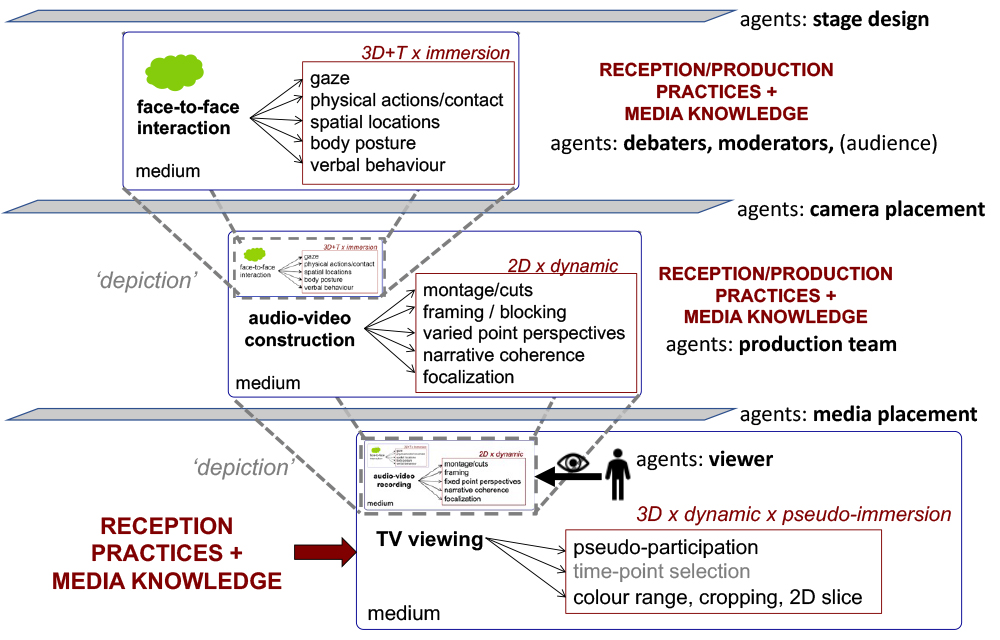
Figure 1: The multiply embedded materiality participating in creating and viewing a TV presidential debate
One function of the diagrammatic representation used here is to emphasise that the materialities made available by the two levels discussed so far are completely different from each other. The materiality of the first level is an enclosed three-dimensional dynamic space, whereas that of the second level is a two-dimensional framed dynamic material. Any material traces of the first level are consequently only available as projections in the second layer determined by camera positions and framing. The two levels are also quite disjoint concerning who can ‘shape’ them, i.e., the semiotic agents involved; for all potential interpreters apart from a layer’s respective semiotic agents, that layer’s traces are ‘immutable’, i.e., cannot be changed. Nevertheless, the directionality of the depiction relationship together with an indexical component of the projection construction means that semiotic agents of the depicted medium (the debaters) can still ‘effect’ the traces that are seen in the depicting medium (the TV production)—this is the nature of recording. That influence is only indirect but can still be employed to deliberate effect as will be discussed in a moment.
First, however, to complete the overall picture, we need at least the third layer shown in the diagram as well as it is only at this level that there is an actual intended recipient of the produced TV programme. This is the layer that provides (and provides for) the semiotic agents who actually watch the debate on TV, which is of course a completely different context with its own media reception practices and, again, a completely different materiality. Consequently, and as noted in the diagram, this layer introduces material distinctions of its own capable of being taken up by further semiotic modes. The traces that semiotic agents might leave at this level might involve, for example, selection of a particular size of screen, placement in a room, viewing context (e.g., over breakfast, while performing other tasks, etc.), and so on. The depicted medium at this level is the finished TV programme, which, for the agents of the final layer, constitutes an immutable materiality which cannot be altered in any way.[10]
This decomposition of the overall situation and its identification of the varied materialities and semiotic agents involved then offers a more finely nuanced view of just which aspects of the entire event are shaped by which mediality, when, and by which semiotic agents. Moreover, each of these performances can be subject to continued and varying conventionalisation at each level. For example, an aspect such as the increased use of split screens when presenting such events is provided by the second layer in the diagram as one of the many kinds of traces that can be inscribed in its materiality. Whether or not particular semiotic agents of the production team actually use this possibility of the material is a distinct question in its own right. The use of split screens supports certain novel reception practices, such as constantly tracking in close-up an interactant’s responses to the situation, and it is these practices that have motivated the technique’s broad adoption—and occasional critique (cf., e.g., Scheufele et al. 2007). As always, however, there is not just a sudden medial practice of having split screens, this is a possibility of the materiality and may be taken up by a semiotic mode for meaning making. It is the semiotic modes that provide the meanings that the medial practices are performing.
Although this decomposition of the communicative situation can appear complex, it is important to appreciate that each of the levels distinguished can be approached analytically in precisely the same way. As illustrated in detail in Bateman et al. (2026: 94-97), providing such slices of materiality should always be taken as the first step of analysis since it anchors methodologically the subsequent steps of explaining observed materiality regularities in terms of the semiotic modes that can be hypothesized as functioning. This turns analysis into a tightly focused discovery procedure capable of guiding analysts to ask particular questions rather than others. This naturally reveals any gaps in analysis that can then be taken up by developing more semiotic modes or by seeking further sources of constraint.
This approach also helps place some of the interactions across levels and media depictions in a sharper light. As mentioned above, the indexical relationship holding between depicted media and their ‘images’ in depicting media extends the material range of those depicted media’s semiotic agents. In particular, and as often observed, when sufficiently experienced, the agents of the top, base layer—particularly, but not only, the politicians—may well use aspects of their performances strategically. Whereas gaze and facial expressions might function within the materiality of the base layer to draw in the audience, their physical placement, body posture, facial expressions, etc. may be performed not in reference to the audience but in reference to their knowledge of how the camera work of the second layer will end up presenting this to the ‘audience at home’ in the third layer. It is then the semiotic agents’ awareness of the materialities and media practices of the other layers that is important.
This is a crucial component of the ‘medial shaping’ that Luginbühl and Schneider discuss, placing a slightly different, and complementary, twist on their observation that:
The candidates’ gaze work, the way they use the studio room, how they walk, align and disalign their bodies are all shaped by the medium of television. As in language use, the effect of the medium is not secondary. The medium itself influences the behaviour of the persons on screen from the outset and creates its own reality of the conversation, a reality that cannot be experienced at the location itself. (Luginbühl/Schneider 2020: 84 f.)
Although no doubt true, we can now pull apart for detailed analysis just which aspects of the ‘medium’ of television are relevant for the deployment of, or engagement with, which semiotic modes by which agents. The materiality available for semiotic agents is in all cases a possibility for action and so one can, on the one hand, certainly talk of that materiality ‘shaping’ agents’ performances, but equally, on the other hand, that materiality is available for active shaping, for leaving traces. This ‘medial’ influence is then clearly one of mutual constraint and also, as always, needs to be seen from the dual poles of potential and actual. All materialities act in this way by definition.
As Luginbühl/Schneider (2020: 58) point out: “the spatial arrangement and camerawork create meaning” and “the protagonists both use the affordances of this special mediality and have their behaviour shaped by it”. But untangling the ‘medial traces’ (Krämer 1998) active in such shaping without first explicitly distinguishing between the contributing layers of materiality, their interrelationships, and their semiotic agents leaves us with a far more challenging task than need be. In contrast, knowing what the material possibilities are allows us to engage effectively with just those semiotic modes relevant for the interpretation of any design decisions made. In other words, in order to untangle such relationships appropriately, one needs to know just which materialities (at which levels) are involved and for which semiotic agents those materialities are ‘mutable’, i.e., available for leaving traces.
Consequently, as noted above, the materialities that can be affected in this way are by no means restricted to the individual ‘layers’ shown in the diagram because the ‘reach’ of semiotic agents is naturally extended by depiction—in particular, by the indexicality of depiction.[11] Since a semiotic agent may be aware that their immediate material context is being depicted in further media, they may ‘design’ immediate material deformations in a manner that transport in specifically intended ways when depicted. This is probably the essence of all recorded or mediated ‘performance’.
Therefore, although “a communicative practice is always co-dependent on individual abilities” (Luginbühl/Schneider 2020: 85), what those abilities can bring about remains dependent on the supporting materialities involved and so vary as those materialities vary. This naturally means that we must always consider the possibilities and practices of the depicting media as well.
In summary, semiotic mode consequently remains essential for theorising medium adequately because, with it, it becomes clearer that materiality enters into discussion of the nature of ‘medium’ along two quite distinct paths. And these different paths take up very different semiotic work anchored in distinct systems of conventions. One path is that provided directly by semiotic mode: this is the materiality that is required for any semiotic mode to be able to function since each semiotic mode has its own material requirements and commitments. The other path is that provided by the composite materiality contributed by a medium not only by virtue of the semiotic modes that it mobilises but also by the institutionalised applications of the ‘technology’ involved. Whereas the former, the characterisation of the material commitments of semiotic modes, is primarily a semiotic affair, the latter is always a sociocultural reading of a state of communication technologies, with all the economic, social and ideological connections that such technologies enmesh. Slicing materiality appropriately then offers a robust methodology by which these diverse contributions can more readily be ordered and related.
5 Conclusion and outlook
Given that ‘medium’ is already such a fraught term, with many partially overlapping and competing definitions, it might be questioned whether yet another ‘view’ is productive. Nevertheless, the proposal of this position paper has been that starting in on the phenomena loosely circulating under ‘medium’ and ‘media’ from multimodal semiotics not only complements previous discussions but can also offer some new opportunities for clarification, synergy, and integration of ideas. In particular, the richly extended notion of ‘materiality’ recently developed in multimodal semiotics has been proposed as a beneficial foundation for reconceptualising and strengthening notions of ‘medium’, particularly those notions related to institutional and social configurations and the effects of these configurations on communication of all kinds.
This is largely supportive of Luginbühl/Schneider’s (2020: 57) position that “every human sign-based interaction is shaped by medial aspects from the outset”, but concerns itself more with the question of just which medial aspects are shaped where and how. Difficult methodological questions concerning how this phenomenon is to be approached analytically remain. We need, therefore, to add further differentiation to the general point that “Media do not only determine which signs we use but they also have an influence on how we use them” (Luginbühl 2015: 14). Although this is certainly the case, there are several quite distinct kinds of ‘determination’ and ‘influence’ in play. Consequently, attempts to characterize this complexity have remained under-differentiated, even when addressed using media linguistic models that exhibit more fine-grained internal structure, such as Brock/Schildhauer’s (2017) view of communication forms as chains of potential relating materials, tools, sign systems, situation types, genres, and more. Notions of technical media, semiotic systems, and situations receive very particular placements within our model of multimodality and it is this that allows us to explore more tightly just where useful boundaries in analytic responsibilities may be set.
Thus, although institutionalised social practices must be accepted as crucial for any semiotically-informed notion of ‘medium’, the detailed study of such institutions is not necessarily specifically a task for multimodality. The multimodal perspective is in fact only relevant when one needs to analyse the achievement of communication by institutions and similar social configurations. At that point the model makes a host of methods available for pulling apart communicative practices in a manner that is both highly detailed and appropriate for foregrounding medial contexts. Other questions may well be handled more appropriately by social studies, ethnography, organisational studies, and the like. It is then interesting to consider where (and why) ‘media linguistics’ may best be placed from such a perspective.
Would media linguistics actually have the same kind of supportive status as multimodal semiotics when addressed to media, but focused more specifically on the verbal forms of expression? Would that then perhaps be simply the ‘linguistic slice’ of a more generally situated multimodal semiotics? Meiler has argued that media linguistics is “not so much in need of single case studies of infrastructural development as it is in need of systematic determinations of the infrastructural foundations of communication forms” (2017: 60) and I have argued here that this is precisely where more finely articulated and semiotically-motivated accounts of multimodality may contribute. Indeed, without such support, it remains uncertain just how systematic such determinations will be able to become. What is clear, however, is that bringing these perspectives together more productively will require considerable further discussion.
References
Bateman, John A. (2011): The Decomposability of Semiotic Modes. In: O’Halloran, Kay L./Smith, Bradley A. (eds.): Multimodal Studies: Multiple Approaches and Domains. London: Routledge (Routledge Studies in Multimodality), 17–38.
Bateman, John A. (2016): Methodological and theoretical issues for the empirical investigation of multimodality. In: Klug, Nina-Maria/Stöckl, Hartmut (eds.): Handbuch Sprache im multimodalen Kontext. Berlin: De Gruyter Mouton (Handbücher Sprachwissen, 7), 36–74.
Bateman, John A. (2021): Dimensions of Materiality: Towards an External Language of Description for Empirical Multimodality Research. In: Pflaeging, Jana/Wildfeuer, Janina/Bateman, John A. (eds.): Empirical Multimodality Research: Methods, Evaluations, Implications. Berlin: De Gruyter, 35–64.
Bateman, John A. (2025): Multimodality writes back. Refining the contextual variable of “mode” in systemic functional linguistics. In: Language, Context and Text 7 (1), 1–41.
DOI: 10.1075/langct.00082.bat
Bateman, John A./Wildfeuer, Janina/Hiippala, Tuomo (2017): Multimodality—Foundations, Research and Analysis. A Problem-Oriented Introduction. Berlin: De Gruyter Mouton.
Bateman, John A./Wildfeuer, Janina/Hiippala, Tuomo (2020): A question of definitions: foundations for multimodality. A response to Charles Forceville’s review. In: Visual Communication 19, 317–320.
DOI: 10.1177/1470357219898599
Bateman, John A./Heller, Vivien/Moschini, Ilaria/Sindoni, Maria Grazia (2024): Genre beyond boundaries: Towards a definition. In: Stukker, Ninke/Bateman, John A./McNamara, Danielle/Spooren, Wilbert (eds.): Multidisciplinary Views on Discourse Genre: A Research Agenda. London and New York: Routledge (Routledge Research in Language and Communication), 47–84.
Bateman, John A./Wildfeuer, Janina/Hiippala, Tuomo (2026): Multimodality—A Hands-On Guide. Berlin: De Gruyter Mouton.
Bolter, Jay David/Grusin, Richard (1999): Remediation: Understanding New Media. Cambridge, MA: MIT Press.
Brinker, Klaus (1985): Linguistische Textanalyse: Eine Einführung in Grundbegriffe und Methoden. Berlin: Erich Schmidt Verlag.
Brock, Alexander/Schildhauer, Peter (2017): Communication Form: A Concept Revisited. In: Brock, Alexander/Schildhauer, Peter (eds.): Communication Forms and Communicative Practices. New Perspectives on Communication Forms, Affordances and What Users Make of Them. Bern: Peter Lang, 13–43.
Dürscheid, Christa (2005): Medien, Kommunikationsformen, kommunikative Gattungen. In: Linguistik Online 22, 3–16.
DOI: 10.13092/lo.22.752
Elleström, Lars (2010): The modalities of media: a model for understanding intermedial relations. In: Elleström, Lars (ed.): Media Borders, Multimodality and Intermediality. Basingstoke: Palgrave Macmillan, 11–50.
Gardner, Rod/Blythe, Joe/Mushin, Ilana/Stirling, Lesley/Dahmen, Josua/de Dear, Caroline/Possemato, Francesco (2025): The Making of Multi-Unit Turns: A spring-loaded door. Amsterdam/Philadelphia: John Benjamins Publishing Company.
Halliday, Michael A. K. (1978): Language as Social Semiotic. The Social Interpretation of Language and Meaning. London: Edward Arnold.
Hausendorf, Heiko (2013): On the interactive achievement of space—and its possible meanings. In: Auer, Peter/Hilpert, Martin/Stukenbrock, Anja/Szmrecsanyi, Benedikt (eds.): Space in Language and Linguistics. Geographical, Interactional, and Cognitive Perspectives. Berlin: De Gruyter, 276–303.
Holly, Werner (2011): Medien, Kommunikationsformen, Textsortenfamilien. In: Habscheid, Stephan (ed.): Textsorten, Handlungsmuster, Oberflächen: Linguistische Typologien der Kommunikation. Berlin: De Gruyter, 144–163.
Hutchby, Ian (2001): Technologies, Texts and Affordances. In: Sociology 35 (2), 441–456. DOI: 10.1177/S0038038501000219.
Innis, Harold A. (1949): The Bias of Communication. In: The Canadian Journal of Economics and Political Science /Revue canadienne d’Economique et de Science politique 15 (4), 457–476.
URL: http://www.jstor.org/stable/138041
Jenkins, Henry (2008): Convergence Culture: Where Old and New Media Collide. New York: NYU Press.
Kaindl, Klaus (2020): A Theoretical Framework for a Multimodal Conception of Translation. In: Boria, Monica/Carreres, Ángeles/Noriega-Sánchez, María/Tomalin, Marcus (eds.): Translation and Multimodality. Beyond Words. Abingdon and New York: Routledge, 49–70.
Krämer, Sybille (1998): Das Medium als Spur und Apparat. In: Krämer, Sybille (ed.): Medien—Computer—Realität. Wirklichkeitsvorstellungen und neue Medien. Frankfurt am Main: Suhrkamp, 73–94.
Levinson, Jerrold (1998): Wollheim on Pictorial Representation. In: The Journal of Aesthetics and Art Criticism 56 (3), 227–233.
Luginbühl, Martin (2015): Media Linguistics: On Mediality and Culturality. In: 10plus1: Living Linguistics 1, 9–26.
URL: http://10plus1journal.com/wp-content/uploads/2015/09/00_OPENER_Luginbuehl.pdf.
Luginbühl, Martin/Schneider, Jan Georg (2020): Medial Shaping from the Outset: On the Mediality of the Second Presidential Debate, 2016. In: jfml: Journal für Medienlinguistik / Journal for Media Linguistics 3 (1), 57–93.
DOI: 10.21248/jfml.2020.34
Martin, James R. (1992): English Text: Systems and Structure. Amsterdam: Benjamins.
McLuhan, Marshall (2002 [1964]): The medium is the message. In: Understanding Media: the extensions of man. London: Routledge (Routledge Classics), 7–23.
Meiler, Matthias (2017): Media Linguistics and Media Studies—Communication Forms and Their Infrastructures. In: Brock, Alexander/Schildhauer, Peter (eds.): Communication Forms and Communicative Practices. New Perspectives on Communication Forms, Affordances and What Users Make of Them. Bern: Peter Lang, 45–66.
Meiler, Matthias (2019): Zur praxeologischen Verhältnisbestimmung von Materialität, Medialität und Mentalität oder: Medien als Praxis. In: Zeitschrift für Semiotik 41 (1–2), 63–88.
Mondada, Lorenza (2013): Interactional space and the study of embodied talk-in-interaction. In: Auer, Peter/Hilpert, Martin/Stukenbrock, Anja/Szmrecsanyi, Benedikt (eds.): Space in Language and Linguistics. Geographical, Interactional, and Cognitive Perspectives. Berlin: De Gruyter, 247–275.
Newall, Michael (2003): A restriction for pictures and some consequences for a theory of depiction. In: The Journal of Aesthetics and Art Criticism 61 (4), 381–394.
Ryan, Marie-Laure/Thon, Jan-Noël (eds.) (2014): Storyworlds across Media. Toward a Media-Conscious Narratology. Lincoln and London: University of Nebraska Press.
Scheufele, Dietram A./Kim, Eunkyung/Brossard, Dominique (2007): My Friend’s Enemy: How Split-Screen Debate Coverage Influences Evaluation of Presidential Debates. In: Communication Research 34 (1), 3–24.
DOI: 10.1177/0093650206296079
Schmitz, Ulrich (2016): Multimodale Texttypologie. In: Klug, Nina-Maria/Stöckl, Hartmut (eds.): Handbuch Sprache im multimodalen Kontext. Berlin: De Gruyter Mouton (Handbücher Sprachwissen, 7), 327–347.
Wildfeuer, Janina (2024): Mediality vs. materiality: A multimodal perspective on the notion of media as procedures. In: Luginbühl, Martin/Schneider, Jan Georg (eds.): Media as Procedures of Communication. John Benjamins Publishing Company, 16–39.
DOI: 10.1075/pbns.348.02wil
Winkler, Hartmut (2008): Zeichenmaschinen: oder warum die semiotische Dimension für eine Definition der Medien unerlässlich ist. In: Münker, Stefan/Roesler, Alexander (eds.): Was ist ein Medium? Frankfurt am Main: Suhrkamp Verlag, 211–222.
Wollheim, Richard (1980): Seeing-as, seeing-in, and pictorial representation. In: Art and its Objects. With Six Supplementary Essays. Cambridge: Cambridge University Press, 137–151.