Vol 8 (2026), No 3: 212–243
DOI: 10.21248/jfml.2026.124
Note from the editors: This article is part of the Quo Vadis special issue and was therefore not subject to a peer-review process.
Format negotiation as an emerging field for media linguistics?
Case studies from (fluid) digital environments (Article)
Abstract
Foregrounding negotiations as forms of meta‑interactions that align user practices with platform affordances and algorithmic constraints, we introduce format (Schildhauer & Brock 2024) as an analytical lens for media linguistics. Format captures (i) potentiality (the range of mediated affordances) and (ii) procedurality (the negotiated actualisation of those affordances). Two empirical studies illustrate its utility. A Zoom‑seminar analysis shows participants co‑constructing a digital seminar‑workshop format by negotiating reaction and turn‑taking features. A multimodal study of twelve YouTube commentary videos (and their comments) reveals ongoing renegotiation of self‑censorship as a format feature in response to algorithmic pressures and audience expectations. Findings demonstrate that format negotiation operates on multiple scales (local vs global, explicit vs implicit, established vs emergent) and across communicative levels, from comment sections to the whole platform. By integrating format more firmly into media-linguistic theory, the article suggests a new research avenue for exploring mediated communication in fluid Web 3.0 environments.
Keywords: format, negotiation, algorithmicity, affordances, self-censorship
1 Introduction
From “Spotify Wrapped” to the 2026 German debate on social media restrictions for adolescents—social media, their algorithms and their potential impact on our life worlds have gained a key position in media-related public discourses. This contemporary phenomenon illustrates two interconnected notions which our contribution0F[1] is based on.
First, Stalder (2017) identified algorithmicity as a central aspect of digital culture. The concept describes how digital environments, and particularly social media platforms, depend on machine-learning-based algorithms and artificial intelligence to moderate, regulate and personalise content. Not surprisingly, then, Herring’s (2019) overview of the historical development of research on computer-mediated discourse tentatively suggests the current development from Web 2.0 to a Web 3.0, which is shaped by algorithmic moderation practices and artificial intelligence. From the perspective of actor-network theory, such algorithms can be assigned a form of co-authorship of users’ social media feeds (Eisenlauer 2014; Leander/Burriss 2020), and this ‘agency’, in turn, is oriented to when participants conceptualise ‘the’ algorithm of a given platform and shape their communicative practices accordingly (Jones 2021). Among others, users appear to expect the algorithm to have a decisive effect on the creation of digital communities and, hence, on participation frameworks: During their political exchanges in the context of the 2020 US presidential election, for example, democrat users expressed surprise when their posts were invaded by ‘Trumpies’, with users expecting the algorithm to keep the two political communities separated (Schildhauer 2022). These initial observations lead us to assume that algorithmicity may have far-reaching consequences for the study of genre, discourse and text-making practices (e.g. Willenberg forthcoming)—an aspect worth focusing on more in media linguistic research.
Essentially, this illustrates our second point of departure, framed by Androutsopoulos as the “interplay between ‘technical infrastructures’ and ‘socially constituted semiotic procedures’” (Androutsopoulos as qtd. in Luginbühl/Schneider 2024a: 4). Naturally, this interplay is influenced by various aspects, such as “genres that are in play and the communicative competence of the individuals taking part in the communication” (Luginbühl/Schneider 2024b: 93). In this contribution, however, we would like to raise awareness of the importance of negotiations among media users in that regard. By negotiation, we here understand meta-interactions that focus on the role that technical infrastructures and the usage offers they make (i.e. their affordances: Hutchby 2014; Pentzold/Fraas/Meier 2013) can and should play in the situated exchanges at hand.
These “acts of making the medium procedural” (Schildhauer/Brock 2024: 61), i.e. the procedural character of mediated communication, have recently been drawn attention to (Luginbühl/Schneider 2024a). Here, we argue that this aspect can be particularly fruitful when considering the persistent challenges posed for the linguistic study of online-mediated communication by the highly dynamic and fast-paced nature of specifically digital environments. Already with regard to Web 2.0, Lomborg (2014), for example, showed how the shape of blogging practices and, hence, the use of medial affordances, was negotiated between bloggers and their audiences. We assume that Web 3.0 environments constitute an even more fluid playing field on which negotiation processes become increasingly relevant: Following algorithmic suggestions, users may frequently ‘stumble’ into digital communities of practice that form loosely and dynamically around certain interests (e.g. hashtags as well as certain accounts and channels; see, e.g., Busch 2025; Kabatnik 2025; Kemper/Schildhauer 2025). In these fluid communities, we argue, socially constituted semiotic procedures constantly have to be (re-)negotiated. This happens, among others, in relation to (algorithmic) technical infrastructures.
In this article, we argue that the concept of format (Schildhauer/Brock 2024) can be used as an analytic lens that can address how participants in fluid digital environments deal with shifting affordances and the increasing algorithmic pressures to negotiate existing and emergent communicative practices. This conceptualisation builds on previously established notions concerning communication forms (Brock/Schildhauer 2017), a model which “collects a number of medial, communicative and textual circumstances” (Schildhauer/Brock 2024: 41). The added dimension of format highlights the fact that it is essential for media linguistic research to consider negotiation processes as a key aspect of mediated communication in the face of constantly changing and evolving environments. We suggest that the flexibility of formats as “more selective and/or more detailed realisations of genres” (Schildhauer/Brock 2024: 46) is particularly useful as a concept to frame media linguistic research objects.
As an illustrative example of the dynamics that underpin our argument, we can look to the video-sharing platform YouTube. YouTube has changed its content moderation and presentation practices multiple times in the past decade since implementing automatic content moderation in 2017. Algorithms such as the ones used on YouTube and similar platforms can be considered ‘black boxes’ (Ananny/Crawford 2018), which means that users have to constantly (re-)assess the platform affordances and thus adjust their communicative practices. Therefore, YouTube users may orient to ‘the’ algorithm (Willenberg forthcoming; Calhoun/Fawcett 2023 for similar processes on TikTok) and include its perceived effects in their negotiations of specific formats.
In the following, we will first outline the theoretical grounding of format, and its relevance to media linguistics (Section 2). Highlighting the fact that almost all areas of life are permeated by digital media in a deeply mediatised world (Hepp 2020) and that various digital environments, apart from social media platforms, necessitate format negotiations, we illustrate our theoretical considerations with data from a Zoom seminar session. We then use Section 3 to hone this approach further by turning to a case study of YouTube commentary videos as an example of a fluid Web 3.0 environment, employing methods informed by multimodal discourse analytic approaches. Finally, we discuss the implications of our findings for broader media linguistic theorising (Section 4).
2 Format as a Lens to Study Medial Negotiations
At the core of the format model that we would like to propose here are the two notions of a) potentiality (Brock/Schildhauer 2017) and b) procedurality (Schildhauer/Brock 2024). In what follows, we turn to each subsequently and illustrate our account with insights gained from our 2024 Zoom study (Schildhauer/Brock 2024). This study is related to a Zoom seminar session conducted in the context of the COVID-19 pandemic. As the guest lecturer and the audience did not know each other and because the use of Zoom had only recently emerged as a practice in university education, the use of some features of the software had to be negotiated, i.e. made procedural by selecting them from the range of features offered by the software and by loading them with communicative value.
Generally, Zoom—just as video conferencing software in general (Mondada 2007)—can be understood as a specific communication form, i.e. as a “cluster[…] of technical and communicative constellations with certain potentials” (Brock/Schildhauer 2017: 32). As roughly outlined in Figure 1 below, these potentials are based on a technical medium, which encompasses computer hardware, general software such as operating systems and transmission protocols, as well as the Zoom software itself.
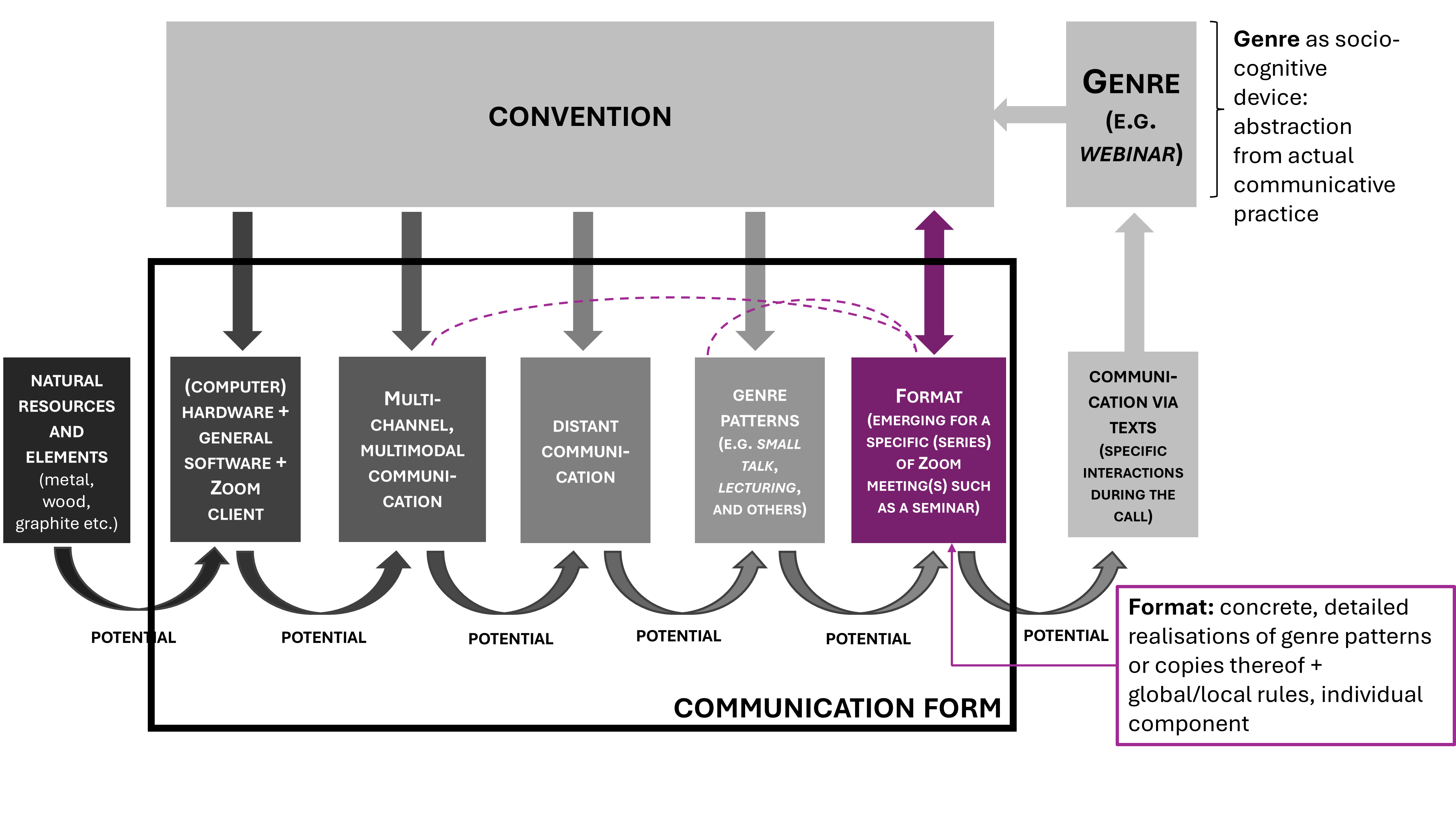
Figure 1: A model of the communication form Zoom call with a focus on its use in educational (e.g. webinar) contexts (see below)
This software provides a range of communicative channels: Obviously, users can connect via camera and/or audio, but Zoom also offers in-built chat, emojis and other reaction features to enable participation on various channels (Cirucci 2023). All of these relate to the overall potential of distant communication of a kind that might create the illusion of co-presence (e.g. Hausendorf 2020; Pekarek Doehler/Balaman 2021) or, more precisely, a new form of co-presence that Hausendorf (2025: e.g. 26) calls Telekopräsenz (tele-co-presence) and that transfers (and transforms) analogue conceptions of ‘being together in one three-dimensional room’ into a digital sphere that assembles “talking heads” on tiles (ibid.; see also Linz 2023).1F[2] At the same time, some potentials are not part of this communication form: Most notably and despite the illusion of co-presence, video conferencing software still creates the eye contact dilemma, which means that gaze cannot be used as a turn-taking device (Hjulstad 2016).
This illustrates how certain genre patterns are (not) enabled as the next step in the potentiality chain, in which one element consecutively enables the next range of potentials (Brock/Schildhauer 2017: 29): While, for example, genre patterns of instructional formats such as lecturing, explaining, questioning etc. can be activated within the communication form Zoom call (i.e. are enabled by it), others, such as reprimanding individual students by using a stern gaze, are (usually) not (Hjulstad 2016: 338; Zima 2024: 287).2F[3]
At each point of the potentiality chain, the choice as well as availability of potentials may also be influenced by conventions: Linz (2023: 243–244), for example, highlights that certain preferred discourse practices may already be inscribed into the Zoom software itself (or even specific licenses issued, e.g., to educational institutions). The software favours constellations that are centered on one participant (host), to whom the software offers specific means of establishing shared attention (e.g. via the share screen feature) and managing turn-taking (see below, e.g. via a specific view of participants who signal their readiness for contributing to a discussion). Leaving these inscriptions aside, it is hardly part of established conventions in educational settings to use Zoom avatars or the fake moustache features provided by the software, for example. These conventions can be established implicitly, by ongoing practice (i.e. communication via texts), or explicitly, e.g. by declaration at the beginning of or during a seminar (Schildhauer 2023).
This is the point where procedurality comes into play, which highlights the role of media users in selecting among the various affordances (potentials) offered by a certain medium for their current (here: communicative) needs. Thus, the concept implies a perspective shift from ‘static’ media as tools or containers Androutsopoulos (2024: 293–295) to “media-in-practice” (Androutsopoulos as qtd. in Luginbühl/Schneider 2024: 4) and to how media users load selected medial affordances with communicative value (Schildhauer/Brock 2024: 61). These “acts of making the medium procedural” (ibid.) are a matter of negotiation among the participants.
We understand negotiation here primarily in an ethnomethodological-conversation analytic sense as a meta-pragmatic (Busch 2024) practice of gradually establishing the “methods persons use in doing social life” (Sacks 1985: 21), which includes processes of selecting from and appropriating medial affordances for current communicative needs. However, our understanding also goes beyond a traditional conversation analytical framework: In a broader sense, communicative conventions established in a given community and/or communicative needs not catered to yet by medial affordances may be taken up by platforms as incentives for re-adjusting the medial affordances of their software. For example, boyd/Golder/Gilad (2010) show how the practice of @-addressing first emerged as a convention in the Twitter community and then was implemented by the platform as an automatically-generated hyperlink that facilitated Twitter interaction.3F[4]
Generally, these negotiations can be described along different dimensions:
• local vs. global: In some instances, negotiation results are intended to be global, i.e. supposed to hold for the entire duration of the format. Depending on the scope of the format, this may comprise, for example, one communicative event (as in the workshop example discussed below) or several communicative events (e.g. various sessions of a seminar or, as our data in Section 3 show, a range of YouTube videos). Local negotiations, in contrast, have a smaller scope, such as a specific sequence at hand.
• explicit vs. implicit: Negotiations may take place implicitly, for example, by silent agreement, or explicitly via meta-communication.
• established vs. emergent: Negotiations may draw on established genre patterns, or they may lead to new patterns emerging (see Section 3 for examples).
Our Zoom seminar data, for example, contains an extended sequence in which the use of the reactions feature is negotiated as a turn-taking device explicitly, with an intended global scope and drawing on established patterns:
|
1
2
3
4
5
6
7
8
9
10
11
25
26 27
28
29 30
31
32
33 34
35
36 |
GL:
OI: GL:
OI: GL:
S1: |
ehm (--)ich würde gern die eh interakTION hIEr, uhm (--) I would like this interaction here wenn sie ehm WORTmeldungen haben, if you’d like to say something gerne auch genau über diese reakTIONen ehm stEUern, (I would like) to steer (it) via exactly these reactions here =<<all>einige haben jetzt schon geSEhen>, some have now already seen =da ist diese (.) | dieses bUtton ehm |HAND heben, |raises hand |raises hand there is this (.) this button uhm ‘raise your hand’ das wäre (.) wenn wir jetzt doch eine relativ GROße gruppe sind- it would be (.) as we are now a relatively big group ehm (.) sehr günstig wenn sie DAS nutzen, it would be practical if you used that weil e:hm | sie dann gewissermaßen für mich ins ZENtrum rUtschen; |swiping gesture because uhm you then sort of move into the centre for me |und ich genau auch Sehen kann; |gesture with both hands And I can see exactly; wer eh gerne beitragen möchte. who would like to contribute. (--)°hh OK – [50 seconds skipped] head closer to the camera, eyes fixed on screen e::hm !AH! ja; u::hm oh yes; OK; <<all>Ich wurde gerade aufmerksam gemacht> dass manche den hAndheben button gar nich !HA:BEN!? I’ve just been made aware of the fact that some don‘t have the button ‘raise hand’? <<all>das is wahrscheinlich dann wieder so ne> verSIONS[fra:ge, This is probably an issue due to different versions again, [nods e::hm (.) dann dAUmen hoch is in ORDnung, u::hm (.) then thumbs-up is alright, und wenn ich_s nich Sehe- and if I don’t see it- dann einfach Mikro [ehm frEIschalten und ehm lOslegen; just activate? your mic uhm and go ahead; [nods NE? Right? [ICH glaube wir kriegen das gerEgelt; I think we’ll manage; [laughs |
Example 1: Negotiating the reactions feature on Zoom (GL = guest lecturer; OI = original instructor; S1 = student 1)
The sequence mainly unfolds between the guest lecturer and the original instructor of the seminar, who apparently both see it as their responsibility to negotiate the interactional framework of the seminar session, and who use various channels (audio-visual, textual) to do so. In the course of the sequence, several features of the Zoom software (raise hand, show raised thumb, unmute mic) are addressed and placed in a preferential hierarchy for signaling a willingness to participate, thus enabling a variant of the established current-speaker-selects-next pattern (Sacks/Schegloff/Jefferson 1974).4F[5] Consequently, these features are selected from a range of affordances provided by the software and loaded with communicative value. Thus, the sequence illustrates precisely what we mean here by medial negotiations as a specific form of meta-interaction.
The result of the sequence is that a certain turn-taking mechanism is established for the duration of the workshop meeting as a specific communicative event. Speaking with our model, the sequence establishes parts of the format of this workshop, as a specific instantiation of the more abstract genre seminar/workshop, from which it borrows certain established genre patterns while rejecting others.
This latter aspect—negotiating a format in opposition to established notions—is illustrated by the following excerpt from our Zoom data:
|
1
2
3
4
5 |
GL:
|
=also (.) wie gesagt s ich möchte ganz wenig eigentlich VORtragen, well, as I said, I would actually only like to lecture you very little, dafür halte ich zOOm auch für sehr UNgünstig, I consider Zoom very unsuitable for that, sondern sehr viel mit ihnen ehm AKtiv Arbeiten, but would rather work with you uhm actively, ehm (.) um wIrklich einmal dinge AUSzuprobieren zu rEflektieren und ehm darüber ins gesprÄch zu kommen. to really try things out, reflect on and uhm discuss them |
Example 2: Negotiating genre patterns in opposition to assumed conventions (GL = guest lecturer)
In these lines, the guest lecturer explicitly addresses various established genre patterns that can be considered part of conventional seminar sessions (or webinars, for that matter), namely vortragen (lecturing), reflektieren (reflecting on), and ins Gespräch kommen (discussing something). The genre pattern of lecturing is rejected, among others, by referring to the affordances of the communication form (line 2) and, thus, by referring to the overall communicative potentials of the Zoom software. Consequently, the sequence is an example of medial negotiations and of how genre patterns can be borrowed selectively to constitute a certain format. It also illustrates how patterns can be integrated into a format in explicit opposition to (perceived) conventions and expectations (indicated by the two-sided arrow between format and conventions in Figure 1).
This also underlines the analytical advantage of the format concept over genre: In line with the situated “bottom-up” approach proposed by Luginbühl/Schneider (2024a: 5), format allows for a fine-grained investigation of a specific communicative event (or series of communicative events) and how its individual local/global roles are negotiated among its participants. Positioned on a medium level between (highly) abstract genres and specific text exemplars, format thus allows to pursue the bottom-up, ethno-categorical approach to medial communication that has been part of the media linguistic tool kit for a while (e.g. Luginbühl 2014) more consistently. We illustrate this in our next section by turning to a case study that focuses on YouTube commentary videos.
3 Case Study: YouTube Commentary Videos
3.1 YouTube
YouTube provides a fertile ground for the study of format negotiation, as it exemplifies the Web 3.0 dynamics mentioned in the introduction. The platform hosts a large variety of heterogeneous video genres and discourse spheres, which are presented to its users with the help of recommendation algorithms (YouTube 2026a). Of particular relevance to this discussion are the Community Guidelines, which function as codified, top-down (i.e. platform-implemented) communicative norms and form the basis of algorithmic content moderation (YouTube 2026b). As the name suggests, these guidelines can be considered part of the overall negotiation of proper (communicative) conduct on the platform in the broadest sense, since developers consider participants’ (including users, advertisers, and content creators) needs, and may adjust these codified norms and their enforcement accordingly (similar to the process of @-addressing on Twitter mentioned above). The automated (i.e. algorithmic) content moderation undertaken by the platform is geared towards the detection of Community Guidelines violations (YouTube 2026b). Based on this, we assume that users may experience algorithmic pressures that influence their communicative practices on YouTube.
Within our communication form model, we can therefore position the Community Guidelines not only as a facet of the conventions influencing the choices in the potentiality chain, but also as part of the platform’s medial infrastructure where they are intertwined with content moderation and recommendation algorithms (see Figure 2). Consequently, the Guidelines and the algorithms may have an effect on format negotiations, similar to how certain features of the Zoom software are used to negotiate the seminar/workshop format. A significant difference to the Zoom example presented above is that YouTube’s communication form allows asynchronous communication, which in turn generates a different set of communicative potentials, including participation frameworks (Goffman 1981; Dynel 2014).5F[6]
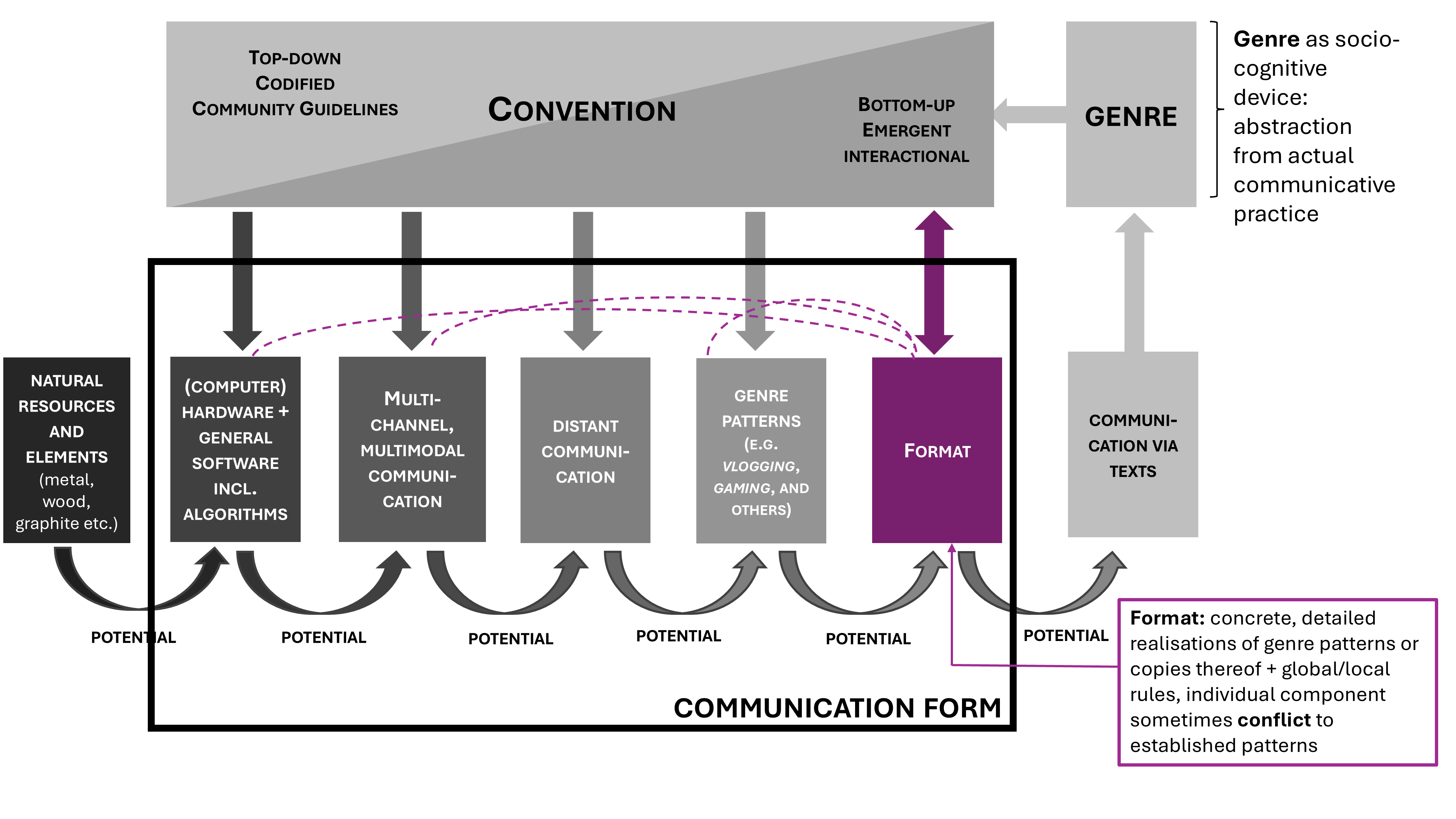
Figure 2: Modified YouTube communication form model for commentary video formats.
In the context of participation frameworks, there are two further aspects to consider. One is the specific role played by an invisible or imagined audience (boyd 2010; Androutsopoulos 2014; Frobenius 2014) in digitally mediated environments. Their position in the participation framework will have an effect on text production and certain communicative practices such as self-censorship (Marwick/boyd 2011; Willenberg forthcoming). Another is the conceptualisation of the aforementioned algorithms as participants in the framework. Previous research has demonstrated that they are assigned a participant status in digital communication forms by other participants (Leander/Burriss 2020; Jones 2021), including both production and reception roles (for the latter see Willenberg forthcoming).
Our case study focuses on YouTube commentary videos, drawing on observations from a research project dedicated to investigating censorship and self-censorship on YouTube (Willenberg forthcoming). Based on the material collected, commentary videos are here tentatively considered a genre of YouTube video, characterised by certain formal, content-related and functional aspects. These include
• Formal presentation: vlog style and/or voice-over, embedding of clips/social media posts
• Content: controversial topics or figures, ‘YouTube dramas’ (Burgess/Green 2018)
• Function: commenting (e.g. on other YouTube videos), reporting, humour elicitation, relationship-building
While YouTube itself offers a categorisation system for its content, a closer examination reveals that they do not align with the variety of genres actually present on the platform.
During the initial investigation, formal differences in the videos emerged, pointing towards the existence of different formats between the commentary channels (i.e. the accounts to which videos are uploaded). Most videos in the corpus are filmed in a vlog style, where creators speak directly to the camera; however, some videos employ voice-over only or feature a facecam. The incorporation of third-party content (i.e. audiovisual material like clips from other YouTube videos, video stills or screenshots of social media posts or comments etc.) also varies. Voice-over-only videos, for instance, typically include more material, while others feature no third-party content at all. This variation also points towards the process of hybridisation (Brock 2021; Hauser/Luginbühl 2015), illustrated by the adoption and rejection of various genre patterns that exist in the communicative space (e.g. derived from genres such as vlogging, make-up tutorials, gaming, reaction videos, video essay, media review, livestream). This is also taken up in the modified communication form model presented in Figure 2 above.
There are some further preliminary aspects to be considered in this context:
• Both video and comment sections as well as entire channels can be seen to be part of what can be called the commentarysphere—a digital discourse sphere on YouTube that consists of both texts, their producers, and their recipients, which can give rise to formats through negotiation. The commentarysphere represents a fluid digital environment typical of the Web 3.0 era.
• Within the commentarysphere, producers must constantly assess and navigate tensions between the discussion of potentially controversial content (e.g. child abuse and exploitation), which YouTube may sanction through automated moderation, visibility restrictions or demonetisation, and audience expectations. Demonetisation directly impacts content creators’ financial incentives. At the same time, it serves as an indirect regulatory mechanism implemented through automated systems, thereby influencing creators’ decisions regarding topic selection, language use, and presentation style. The resulting tensions are negotiated using language and other multimodal resources in both videos and comments.
Formats on YouTube thus emerge as dynamic co-constructions, influenced by both visible (audience interaction) and invisible (algorithmic moderation, monetisation policies) forces, which collectively structure engagement in the commentarysphere.
3.2 Data & Methodology
The corpus for the original study contains 42 YouTube commentary videos and the written comments posted on them (169,526 as of November 2024) and meta-data. The data are organised into three thematic sub-corpora based on recurring topics. These topics were identified with the help of a preliminary reference corpus, and the final videos were selected with the help of YouTube’s search option, using the query “topic + commentary”. This data collection method operationalises the YouTube recommendation algorithm and is based on the assumption that—barring other input—the algorithm suggests content that is similar (cf. Goodrow 2023).
The following data sample is taken from one sub-corpus of the original data set, which contains commentary videos about family vlogging. Family vlogging is a common practice on YouTube where channels upload and monetise content featuring daily life with children. It represents a recurring topic for commentary channels due to the alleged exploitation of children for profit. This data set contains 12 commentary videos and 61,476 comments.
What will be presented here is an investigation into format negotiation in the context of one specific discourse practice, namely self-censorship. Self-censorship can be distinguished from censorship as follows:
[…] censorship is viewed as an action of silencing that occurs in at least two ways: (i) an authoritative body imposes censorship in order to obscure information it believes to be harmful either to itself or to others, and (ii) an individual or a group exercises self-censorship by withholding information believed to be harmful to themselves or others. (Anthonissen 2008: 401, emphasis added, M.W.).
The concept of harmfulness as a potential outcome of communication is pertinent here and, in the digital sphere, connects to Community Guidelines and content moderation more broadly.
We are specifically interested in how the negotiation of self-censorship conventions contributes to the emergence of new video formats. Self-censorship is of interest because of its decidedly multimodal character on YouTube, where participants can utilise the communicative potentials to shape and negotiate communicative norms through the practice. This manifests in multiple different ways, but with some consistency in the videos under consideration here.
To that end, the data were examined using multimodal discourse analysis to “investigate the modal meaning potentials of digital texts and social interaction.” (Jewitt 2015: 75) This methodology fits nicely within the framework of communication forms, format and by extension genre as results and processes of social practice: It allows the researcher to consider all components of our model in detail, moving from micro level of individual signs to macro level of metacommunication. It is our assumption that format negotiation likewise occurs on all these different levels.6F[7]
3.3 Analysis
The commentary videos in this case study report and comment on another communicative practice on the platform—family vlogging. This means that the commentary video genre can be seen as serving a meta-level function of negotiating appropriacy on YouTube.
A key aspect of these negotiations is the question of censorship, which arises in relation to children on the platform. YouTube’s Community Guidelines contain specific policies regarding both the extent to which children can be shown on the platform and what content for minors should look like. This is something producers (i.e. content creators) have to keep in mind when designing their content, as a violation of the guidelines may result in demonetisation or content deletion by YouTube. This is pertinent to the current discussion, since this may lead to the explicit or implicit rejection/acceptance of certain genre patterns and consequently active format negotiation. In the following, we will demonstrate how self-censorship surrounding children and related aspects emerges as a format pattern in commentary videos. This pattern seems to be in conflict with the presence of children in family vlogging content.
3.3.1 Verbal Self-censorship
This process of self-censorship becomes particularly evident on the lexical level, when content creators address highly sensitive or taboo topics related to children. A concrete instance of this can be observed in the treatment of specific lexemes within commentary videos, where creators engage in various strategies to comply with both perceived moderation practices and audience sensitivities.
For instance, we can consider the case of the potentially taboo lexeme paedophile. Its potentially taboo character is evidenced by the fact that it is frequently censored in the family vlogging corpus. The way it is censored is similar across some of the videos: the YouTubers proceed to (partially) mute the lexeme from their spoken articulation. Muting means that an audio cut occurs, i.e. the articulation of the lexeme in question is removed during the editing stage of the video production (see also Willenberg 2024: 111-114).7F[8] This occurs in three videos. The following transcript excerpts showcase this process:
Example 3: Transcript Excerpt “The LaBrant Fam (how not to do family vlogging)” [10:32-10:39]. CM = CCMarie
|
CM: |
It is a well known fact that there are <audio cut> who seek out family vlogging content for those reasons |
Example 4: Transcript Excerpt “THESE FAMILY VLOGGERS HAVE GONE TOO FAR” [11:19-11:29]. SL = Stefanie Lange
|
SL: |
If I thought the p<audio cut> were coming to my channel to consume content that I was really putting out there of my children there is no way in heck my children would still be on my channel at all. |
Example 5: Transcript Excerpt “The Dark Side of Family Vlogging Channels: 8 Passengers” [06:28-06:37]. HE = Hailey Elizabeth
|
HE: |
|
[…] is that in the comments of the videos <audio cut>iles would put the time stamps of when the kids looked most vulnerable. |
It is evident here that the YouTubers use the medial affordances of (online) video production, i.e. the communicative potentials of the communication form, for the purposes of censorship and thus make them procedural for the format in a similar way to the thumbs-up feature on Zoom discussed above. Rather than choosing a different word during the recording of the video, the articulation is removed—though not (always) entirely—in the editing stage, creating a noticeable absence. This can be considered a censorship sign (Willenberg forthcoming; Brock/Willenberg 2025: 53–54), which—while concealing a potentially taboo lexeme—highlights the fact that censorship occurs in the first place. The use, adoption or rejection of censorship signs derived from genre patterns or previous communication can be considered part of format establishment.8F[9] This is noteworthy since YouTube’s Community Guidelines do not explicitly forbid the use of this lexeme. Yet, there seems to be at least a perceived algorithmic pressure to avoid and thus censor this lexeme. In the videos, this choice remains unexplained, pointing towards acceptance of this practice in the commentarysphere. Self-censorship as a format-negotiating technique is consequently situated on the implicit dimension of format negotiation. The fact that these three videos engage in the same pattern leads to the assumption that a format pattern which spans various communicative events is, at least, emergent.
In the multimodal ensemble of the YouTube video, other medial affordances may further be used for self-censorship, as is evident by text shown in CCMarie’s video:
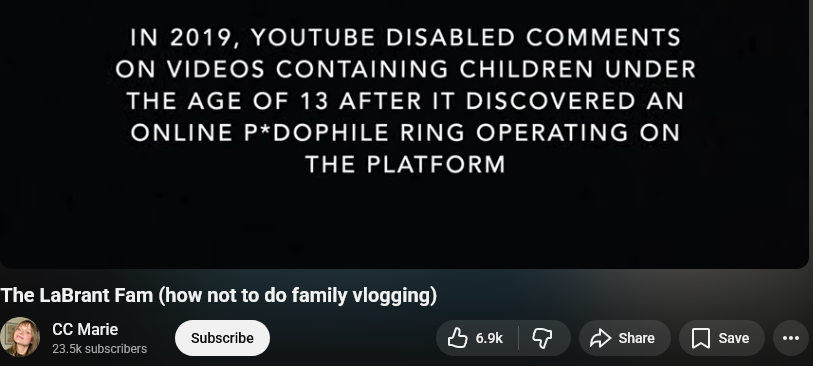
Figure 3: Screenshot from “The LaBrant Fam (how not to do family vlogging)” [10:40]
Here, the same lexeme that was previously censored in the spoken mode is again censored in writing through typographic concealment (Willenberg forthcoming).9F[10] This, once again, affirms the status of the lexical taboo in certain commentary video formats.
We may speculate reasons for this avoidance: First, paedophilia is culturally considered taboo, and thus subject to self-censorship; this would be an instance of conceptual interdiction (Casas Gómez 2018: 14). However, this is most likely not the case in our examples, since the topic of paedophilia and its dangers for the children of family vloggers is still explicitly discussed. Another possible reason is thus an emergent lexical taboo around the word paedophile. There is reason to assume that this is an emerging, bottom-up lexical taboo that becomes part of certain commentary video formats. This becomes specifically clear when considering reactions to the censorship in the comment sections, as evidenced in Example 6:
Example 6: Comment under “THESE FAMILY VLOGGERS HAVE GONE TOO FAR”
Did you edit the noise out when you said “pedophile” in your video or did YouTube do that? Just wondered if that’s censored or if it’s a video edit.
This comment makes a distinction between institutional censorship and video editing, illustrating a question of authorship. The commenter thus assumes the possibility of YouTube as a co-author (in Goffman’s sense of the author-role, and here, more specifically, as a censor), which supports our argument that YouTube algorithms are oriented to as non-human agents (see above) and, thus, exert a considerable influence in the potentiality chain. We will return to such metacommunicative comments and their role in format negotiation in Section 3.3.4.
3.3.2 Conflicting patterns
Censorship also occurs in other modes than language. One prominent example of this in our sample is the censoring of children’s faces in the visual mode, using various visual resources such as blacking out the children’s faces, blurring or covering them with emoji, as shown in Figure 4.
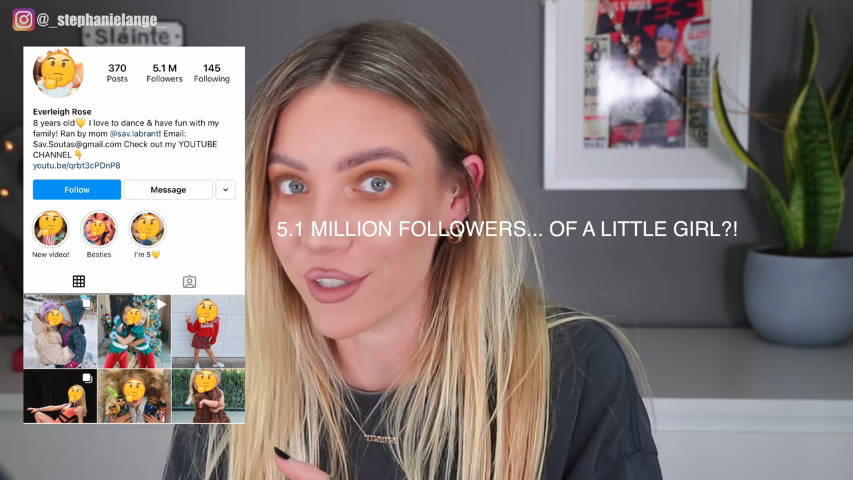
Figure 4: Screenshot from “THESE FAMILY VLOGGERS HAVE GONE TOO FAR” [10:30]
The use of emoji resembling facial expressions in particular allows the YouTuber to achieve two effects simultaneously: 1) the child’s face is effectively censored and 2) the facial expressions of the emoji convey a stance concerning the visual presence of children in the first place. Censorship can thus be considered to be multi-functional in the commentarysphere. More precisely, this YouTuber positions her own format as being in conflict with existing genre patterns of family vlogging, i.e. showing children on YouTube to the public. This opposition shows up in a similar manner in our Zoom data above (Example 2).
This conflict relates to another affordance on YouTube: the possibility to embed third-party content. This option raises questions critical to the practice of self-censorship: who censors what, i.e. the authorship (again, in the sense of Goffman’s author role) of the censorship may not be immediately apparent. An example of this can be seen in the video by commentary channel Hailey Elizabeth (HE). In her video, she embeds a clip showing family vlogging content (06:19-06:27). The clip, however, does not seem to be taken from the original family vlogging video (uploaded to the channel 8 Passengers), but rather from another creator’s video or livestream (Figure 5).
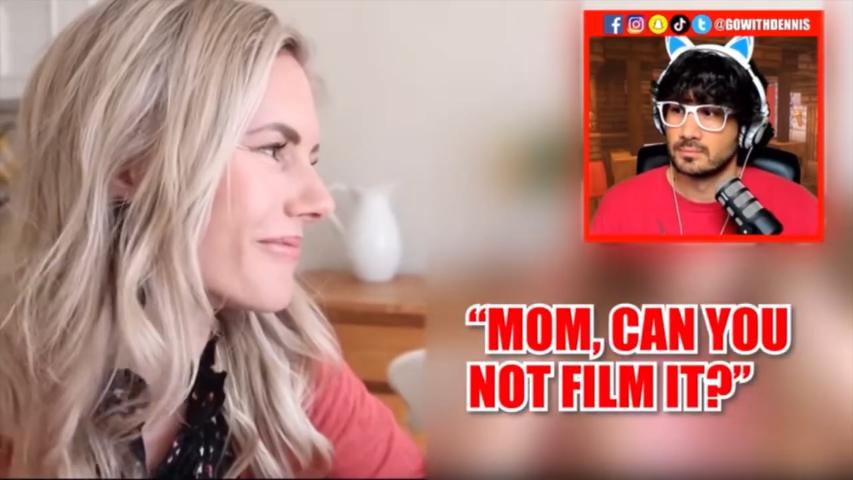
Figure 5: Screenshot from “The Dark Side of Family Vlogging Channels: 8 Passengers” [06:20], portraying a woman speaking to a (blurred) child as well as a superimposed image of another content creator
Before and after the clip, viewers see HE talking to the camera while doing her make-up. In the clip, we see a woman speaking to a child, who is blurred (i.e. censored) on screen. At the same time, a facecam of another content creator and their social media tags (@GOWITHDENNIS) are visible, but they do not speak. This constellation is not elaborated on by HE and is also not questioned in the comments, which indicates an implicit acceptance of embedding as a format feature of the channel. Further, such cases generate a complex hierarchy of embedding and recontextualisation. The procedurality of formats is key here: Individual commentary formats are always situated in a chain of texts, either through embedding or the communicative function of commenting, which is often exophoric. In terms of participation frameworks, the embedding of third-party content may then result in forms of co-authorship, where formal choices—i.e. format features—are imported into new contexts/recontextualised. These formal aspects may then contribute to potentially emerging formats. Since embedding is an affordance of online video facilitated by the technical medium, this potentiality is critical to the negotiation of formats. More specifically, it is of interest to us how exactly the possibility of embedding is utilised to negotiate formats.
Children are not, however, consistently censored in all videos in the sample corpus. This indicates that rigid self-/censorship is not part of the formal or linguistic patterns associated with the commentary video genre, but something that seems to be a part of the individual formats established by commentary channels in the commentarysphere.10F[11]
A number of commentary channels establish the censorship of children as a part of their own format of commentary videos. As there seems to be no consistent norm in terms of child visuals in the commentary video genre, what is happening here is thus not a rejection of genre patterns of commentary videos, but takes place on a higher level, rejecting conventions established in different genres like family vlogging. This shows how format negotiation on YouTube is a multi-layered process, engaging with various genre patterns present on the platform. This is fuelled by the fact that commentary videos—and by extension YouTube videos in general—have to take into account communicative constraints emerging from the embedding of third-party content.
This heterogeneity in terms of self-censorship points towards the central aspect of procedurality in the fluid digital environment of the commentarysphere. Rules and conventions may be less rigid when communities of practice are assembled through algorithmic recommendations. Further, while the Community Guidelines provide some top-down rules concerning communication, they are not clearly defined in terms of how they affect linguistic and multimodal expression. This means that speakers have to engage in a trial-and-error procedure to figure out how to meet their communicative goals (e.g. audience engagement, visibility or monetisation). In other words, selecting from the communicative potentials of YouTube’s communication form in order to self-censor—or refrain from doing so at all—are acts of “making the medium procedural” (Schildhauer/Brock 2024: 61, cf. Section 2).
3.3.3 Metacommunication as format negotiation
In addition to the implicit format negotiation through self-censorship demonstrated by the examples above, members of the commentarysphere can also engage in format negotiation explicitly through metacommunication. It is in such instances that the participant’s orientation towards perceived algorithmic pressures becomes most evident.
One such example can be found in the video by TehMimi (TM). The video discusses another potentially taboo topic: abortion. This in itself is an interesting finding, since this—as opposed to the other topics related to children discussed thus far—is not mentioned in any way in the Community Guidelines. Similar to the cases of verbal self-censorship surrounding the lexeme paedophile, this commentary channel employs different techniques to self-censor the lexeme abortion in their video. These techniques similarly use the modal affordances available on YouTube and include blurring/pixelation of the written word and the use of an x-word construction a-word in the spoken mode. What sets this case apart is that the self-censorship here is accompanied by explicit metacommunication, which also occurs multimodally as shown in Example 7 and Figure 6.
Example 7: Transcript Excerpt “These family vloggers just made the worst video on YouTube” [09:52-10:04]. TM: = TehMimi
|
TM: |
I’m trying to be specific with my wording here because I’ve noticed a lot of videos have been um age-restricted when using the a-word, so I’m not gonna say that. |
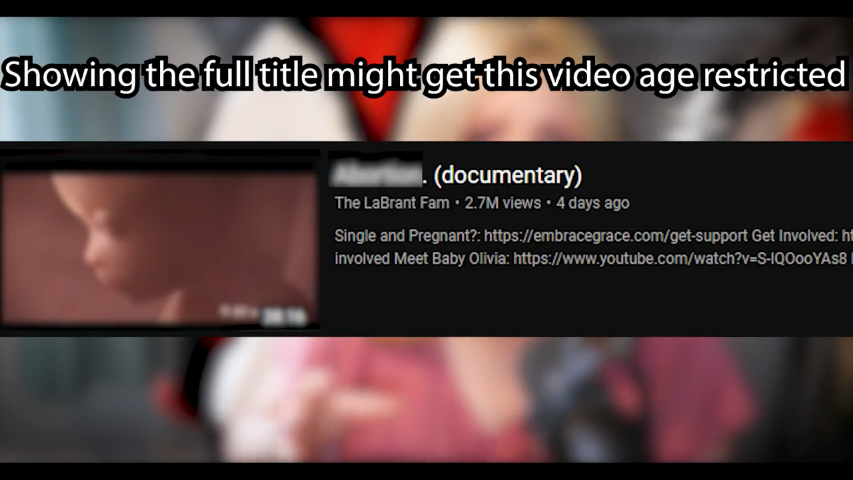
Figure 6: Screenshot from “These family vloggers just made the worst video on YouTube” [08:00]
Age-restriction on YouTube is typically algorithmically achieved and may result in both demonetisation of videos and decreased visibility since users would need an account to view age-restricted videos. It is clearly positioned here as to be avoided. The use of passive sentences obscures the agent of the age-restriction, and the modal might illustrate uncertainties about the taboo status of the word. This fits with the assumption that participants have to contend with algorithmic ‘black boxes’. This commentary channel chooses a better-safe-than-sorry approach of preliminary obedience to perceived algorithmic pressures. The linguistic and visual choices (in the form of self-censorship) are thus explicitly oriented towards a potential overhearer: the content-moderating algorithm (see also Willenberg forthcoming). Format features of this channel are thus negotiated in relation to perceived agency of algorithms and may thus become entrenched in the format. Abortion is conceived as a taboo topic (even though it prompted the commentary video in the first place). In other words, the taboo is part of formats in an algorithmically controlled communicative sphere, rather than in society more broadly. It is then avoidance on the lexical level which allows the discussion of the taboo in this format. Again, the notion of embedding is relevant here: TM censors the video title chosen by another channel, i.e. another video that exists on the platform, in the screenshot shown. The censorship undertaken in her video can be seen as a rejection of communicative practices from other formats (here, documentary) on YouTube.
3.3.4 Format negotiation in the comment section
Considering both YouTube videos and their corresponding comments as data allows the researcher to investigate reactions to specific communicative practices, and this allows insight into the negotiation processes taking place in fluid digital environments. The comment sections of YouTube videos are prime locations for investigating such metacommunication. In terms of studying censorship and self-censorship, a consideration of the comment section provides a unique perspective, since comment sections do not experience monetisation-related pressures, but may self-censor a) to adhere to (perceived) top-down/codified and bottom-up/emergent communicative norms, b) to remain visible and c) to signal group membership.
As such, the negotiation of taboo content and its censorship may be taken up in a video’s comment section. The following comments were left under TM’s video, the first showing an adoption of the self-censored a-word:
Example 8:
My only argument against women getting a-words is if the father is in the picture and doesn't get a choice about his baby. But that’s just me. Otherwise idk lmao your body your choice.
Example 9:
As a teenager, I was brainwashed to have the same exact view on ab0rt10n. [...]
As this last example illustrates, a different form of self-censorship is used, which can be termed typographic replacement (Willenberg 2024: 108–109). Since blurring is not afforded in YouTube comment sections, participants thus use different semiotic resources available in the communicative mode of writing for self-censorship, choosing visually similar characters to obscure the taboo lexeme. As argued elsewhere, typographic replacement seems to be a case of self-censorship not targeted at human recipients, but at algorithmic or automated filters. The visual similarity to the original lexeme suggests that authors want to maintain a degree of readability while still avoiding potentially taboo words. This practice likely has its origins in leetspeak (Perea/Duñabeitia/Carreiras 2008: 237).11F[12]
In addition to adoption of self-censorship techniques, self-censorship as a format feature can also be questioned, as in Example 6, or otherwise explicitly discussed in the comment sections, as the following example illustrates:
Example 10: Comment under “THESE FAMILY VLOGGERS HAVE GONE TOO FAR”
I appreciate the fact that you censored the children’s faces. You are protecting the childrens dignity when the parents won’t.
Here, SL’s censorship choices are affirmed by the commenter, which indicates the acceptance of self-censorship as a formal format feature by recipients. At the same time, the presence of children in family vlogging is criticised, contributing to negotiation of communicative practices on a meta- or platform level. Going back to Figure 2, this example illustrates how formats can be negotiated in relation, and sometimes in conflict, to existing conventions at various levels and can, in turn, influence these (and other) conventions and practices.
While Example 10 shows affirmation of the practice, this is not always the case in our data. Under HE’s video, while affirmation initially takes place, we also find the following replies (15-23):
|
top-level comment |
Can we just appreciate how respective she is to the children, blurring out their faces. We need more people like this, why isn’t she so much bigger?!? |
|
comment reply 1 |
omg, i was thinking the same thing |
|
[14 comments omitted] |
|
|
comment reply 15 |
a lot of you tubers who make videos about family channels actually blur them out too…not even worth praising lmao |
|
comment reply 16 |
I’m sorry but u need to raise your standards, like that is common sense |
|
comment reply 17 |
That’s common knowledge. She shouldn’t be praised for doing the bare minimum lmao |
|
comment reply 18 |
It’s literally the bare minimum |
|
[two comments omitted] |
|
|
comment reply 21 |
I think it’s only for legal reasons |
|
comment reply 22 |
Exactlyy- |
|
comment reply 23 |
@ commenter 17:01 the censoring doesn’t even work and there’s like 2 other kids there |
Example 11: Comment thread under “The Dark Side of Family Vlogging Channels: 8 Passengers”
Critical replies pertain both to the formal as well as the discursive level of self-censorship. It is not only the censorship itself which is negotiated, but also the way it is done (last reply). The first two replies illustrate that certain conventions surrounding censorship of child imagery—both implicit and explicit—seem to exist on YouTube. This not only stands in contrast to the praise of the original comment, but also to the evidence suggested in our sample, where 8 out of 12 commentary videos do show family vlogging content featuring children. These metacommunicative exchanges tell us two things: First, the heterogeneous audience in the commentarysphere has different format expectations for commentary videos. Producers then have to navigate these in their audience design (cf. Bell 1984; Androutsopoulos 2014; Frobenius 2014). Self-censorship can be considered a part of this navigation.
Second, censorship negotiation can be seen as a global or format-crossing pattern on YouTube: Taking the censorship in the video as a point of departure, members of the commentarysphere negotiate the presence of children on the entire platform, i.e. even in different formats than the one they are currently engaged with. This rejection of a communicative practice (showing children in family vlogging) in turn contributes to the format patterns of commentary videos. The negotiation and development of individual formats can thus serve to express users’ perspective on broader discursive values or genre conventions. In contrast to the format negotiations that occur in situ as with our Zoom example above, metacommunication in comment sections will not have an immediate effect on the individual texts/videos they respond to. The procedurality of format negotiation consequently has to consider the temporality (i.e. synchronicity vs. asynchronicity) inscribed in specific online communication forms.
4 Conclusions
This paper demonstrated the application of format as an analytic lens in media linguistics. A modification of the model allows us to comprehensively assess how format is negotiated in fluid digital environments. In this context, the algorithmicity of such environments proved a key factor in ongoing format negotiations. Participants take the algorithmicity of digital environments into account when engaging in format negotiations, for instance when ‘the’ algorithm is oriented to as a non-human agent present in the participation framework.
The adaptability of format as a concept becomes especially apparent in multimodal contexts, where meaning is made on the basis of platforms’ communicative potentials. Here, both potentiality and procedurality are critical, and format provides a useful lens, which allows the assessment of communicative practices on several different analytical levels. This is especially evident when format negotiation processes occur in opposition to existing conventions and genre patterns. Further, we have demonstrated how format can cascade: Existing formats or genre patterns (like seminar/workshop or family vlogging on YouTube) can serve as points of departure for the (re-)negotiation of other formats such as a Zoom lecture or commentary videos, or even commentary video comment sections. Format negotiation is thus a cyclical, dynamic process which considers both medial affordances and platform logics.
It is our assumption that format as a dynamic notion negotiated in specific interactions may be empirically better to grasp than other concepts such as genre as more abstract, relatively stable socio-cognitive devices (Karlgren 2011), and therefore better suited to the media-linguistic investigation of digital communicative environments. It provides an analytical focus that bridges genre as a socio-cognitive device and concrete, observable communicative practices. It can thus be considered a consistent continuation of an ethno-categorical genre approach, and advances it by foregrounding meta-communication and the situated practices through which participants actively constitute and modify communicative frames as a central locus of format negotiation.
References
Ananny, Mike/Crawford, Kate (2018): Seeing without knowing: Limitations of the transparency ideal and its application to algorithmic accountability. In: New Media & Society 20 (3), 973–989.
DOI: https://doi.org/10.1177/1461444816676645
Androutsopoulos, Jannis (2014): Languaging when contexts collapse: Audience design in social networking. In: Discourse, Context & Media 4–5, 62–73.
DOI: 10.1016/j.dcm.2014.08.006
Androutsopoulos, Jannis (2024): Polymedia procedures: A commentary. In: Luginbühl, Martin/Schneider, Jan Georg (ed.): Media as Procedures of Communication. Amsterdam: Benjamins, 292–305.
Anthonissen, Christine (2008): The Sounds of Silence in the Media: Censorship and Self-censorship. In: Antos, Gerd/Knapp, Karlfried/Wodak, Ruth (ed.): Handbook of Communication in the Public Sphere. Berlin: Mouton de Gruyter, 401–428.
Beißwenger, Michael (2004): Sprachhandlungskoordination im Chat. In: Zeitschrift für germanistische Linguistik 31 (2), 198–231.
DOI: https://doi.org/10.1515/zfgl.2004.003
Bell, Allan (1984): Language Style as Audience Design. In: Language in Society 13 (2), 145–204.
DOI: 10.1017/S004740450001037X
boyd, danah (2010): Social Network Sites as Networked Publics. Affordances, Dynamics, and Implications. In: Papacharissi, Zizi (ed.): A Networked Self. Identity, Community, and Culture on Social Network Sites. New York/London: Routledge Taylor & Francis Group, 39–58.
boyd, danah/Golder, Scott/Lotan, Gilad (2010): Tweet, Tweet, Retweet: Conversational Aspects of Retweeting on Twitter. In: HICSS-43.
URL: https://www.danah.org/papers/TweetTweetRetweet.pdf
Brock, Alexander (2021): Hybrid TV Comedy Genres: The Case of Comedy Panel Shows. In: Estudios de Lingüística del Español 43, 9–22.
URL: https://doi.org/10.36950/elies.2021.43.8425
Brock, Alexander/Willenberg, Merle (2025): Humorous self-censorship strategies on YouTube: Semiotic structure and social-semiotic functions. In: Punctum – International Journal of Semiotics 11(1), 51–72.
DOI: 10.18680/hss.2025.0003
Brock, Alexander/Schildhauer, Peter (2017): Communication Form: A Concept Revisited. In: Brock, Alexander/Schildhauer, Peter (ed.): Communication Forms and Communicative Practices: New Perspectives on Communication Forms, Affordances and what Users Make of Them. Berlin: Peter Lang, 13–43.
Burgess, Jean/Green, Joshua (2018): YouTube: Online video and participatory culture. Second edition (Digital media and society series). Cambridge, UK, Medford, MA: Polity.
Busch, Florian (2025): Wissen in Interaktion auf YouTube. Praktiken der interaktionalen Aneignung von Deutsch-Erklärvideos. In: Beißwenger, Michael/Schildhauer, Peter/Gredel, Eva (ed.): Die Kultur der Digitalität im Spiegel von Sprach- und Mediendidaktik. Universitätsbibliothek der Ruhr-Universität Bochum, 316–336.
DOI: https://doi.org/10.46586/SLLD.458
Calhoun, Kendra/Fawcett, Alexia (2023): ‘They Edited Out her Nip Nops’: Linguistic Innovation as Textual Censorship Avoidance on TikTok. In: Language@Internet 21, 1–30.
Casas Gómez, Miguel (2018): Lexicon, discourse and cognition: Terminological delimitations in the conceptualizations of linguistic taboo. In: Pizarro Pedraza, Andrea (ed.): Linguistic taboo revisited: Novel insights from cognitive perspectives. Berlin, Boston: De Gruyter Mouton, 13–32.
Cirucci, Angela M. (2023). Zoom Affordances and Identity: A Case Study. In: Social Media + Society 9 (1), 1–9.
DOI: https://doi.org/10.1177/20563051221146176
Dynel, Marta (2014). Participation framework underlying YouTube interaction. In: Journal of Pragmatics 73, 37–52.
Eisenlauer, Volker (2014): Facebook as a third author: (Semi-)automated participation framework in Social Network Sites. In: Journal of Pragmatics 72, 73–85.
DOI: https://doi.org/10.1016/j.pragma.2014.02.006
Frobenius, Maximiliane (2014): Audience design in monologues. How vloggers involve their viewers. In: Journal of Pragmatics 72, 59–72.
DOI: 10.1016/j.pragma.2014.02.008
Goffman, Erving (1981): Forms of Talk. Philadelphia: University of Pennsylvania Press.
Goodrow, Cristos (2023): On YouTube’s recommendation system. YouTube.
URL: https://blog.youtube/inside-youtube/on-youtubes-recommendation-system/ (accessed 13 March 2023).
Hausendorf, Heiko (2020): Geht es auch ohne Interaktion? In: Aptum, Zeitschrift für Sprachkritik und Sprachkultur 16 (3), 86–89.
DOI: https://doi.org/10.46771/978-3-96769-102-3_13
Hausendorf, Heiko (2025): Kopräsenz: Über das soziale Zuhause von Sprache. Bielefeld: transcript.
Hauser, Stefan/Luginbühl, Martin (2015): “Hybridisierung und Ausdifferenzierung – Einführende begriffliche und theoretische Anmerkungen“. In: Hauser, Stefan/Luginbühl, Martin (ed.): Hybridisierung und Ausdifferenzierung: Kontrastive Perspektiven linguistischer Medienanalyse. Bern et al.: Peter Lang, 7-30.
Hepp, Andreas (2020): Deep Mediatization. London: Routledge.
Herring, Susan C. (2019): The Coevolution of Computer-Mediated Communication and Computer-Mediated Discourse Analysis.” In: Bou-Franch, Patricia/Garcés-Conejos Blitvich, Pilar (ed.): Analyzing Digital Discourse: New Insights and Future Directions. Cham: Springer International Publishing, 25–67.
Hjulstad, Johan (2016): Practices of Organizing Built Space in Videoconference-Mediated Interactions. In: Research on Language and Social Interaction 49 (4), 325–341.
DOI: https://doi.org/10.1080/08351813.2016.1199087
Hutchby, Ian (2014): Communicative affordances and participation frameworks in mediated interaction. In: Journal of Pragmatics 72, 86–89.
Jewitt, Carey (2015): Multimodal analysis. In: Georgakopoulou, Alexandra/Spilioti, Tereza (eds.): The Routledge handbook of language and digital communication. Milton Park et al.: Routledge, 69–84.
Jones, Rodney H. (2021): The text is reading you: Teaching language in the age of the algorithm. In: Linguistics and Education 62, 1–7.
DOI: https://doi.org/10.1016/j.linged.2019.100750
Kabatnik, Susanne (2025): „Hallo Leute, ich bin neu hier und freue mich, Euch kennen zu lernen :)“ – Kommunikative Praktiken der Inklusion im Interaktionsraum #depression auf Twitter/X. In: Aptum. Zeitschrift für Sprachkritik und Sprachkultur 21, 99–122.
DOI: https://doi.org/10.46771/9783967694604_5
Karlgren, Jussi (2011): Conventions and Mutual Expectations: Understanding Sources for Web Genres. In: Mehler, Alexander/Sharoff, Serge/Santini, Marina (Hg.): Genres on the Web: Computational Models and Empirical Studies. Dordrecht: Springer, 33–46.
Kemper, Katharina/Schildhauer, Peter (2025): Reverse Engineering. Sprachdidaktische Überlegungen zur Algorithmizität von Social-Media-Plattformen. In: Beißwenger, Michael/Schildhauer, Peter/Gredel, Eva (Hg.): Die Kultur der Digitalität im Spiegel von Sprach- und Mediendidaktik. Universitätsbibliothek der Ruhr-Universität Bochum (Sprachlich-Literarisches Lernen und Deutschdidaktik: Bände (SLLD-B), 394–419.
DOI: 10.46586/SLLD.458
Leander, K. M./Burriss, S. K. (2020): Critical literacy for a posthuman world: When people read, and become, with machines. In: British Journal of Educational Technology 51 (4), 1262–1276.
DOI: https://doi.org/10.1111/bjet.12924
Linz, Erika (2023): Interaktionsordnungen in Videokonferenzen – Simulationen einer Face-to-Face-Kommunikation? In: Sprache und Literatur 51 (2), 230–255.
DOI: 10.30965/25890859-05002022
Lomborg, Stine (2014): Social Media, Social Genres. Making Sense of the Ordinary. New York, NY: Routledge.
Luginbühl, Martin (2014): Medienkultur und Medienlinguistik: Komparative Textsortengeschichte(n) der amerikanischen „CBS Evening News“ und der Schweizer „Tagesschau“ (Vol. 4). Bern: Peter Lang.
Luginbühl, Martin/Schneider, Jan Georg (2024a): Introduction: Why mediality matters – media as procedures of communication. In: Luginbühl, Martin/Schneider, Jan Georg (ed.), Media as Procedures of Communication. Amsterdam: Benjamins, 1–13.
Luginbühl, Martin/Schneider, Jan Georg (2024b): “Do you have an idea what this clown is doing?”: Multimodal media staging in the first presidential debate and the vice presidential debate 2020. In: Luginbühl, Martin/Schneider, Jan Georg (ed.), Media as Procedures of Communication. Amsterdam: Benjamins, 68–97.
Marwick, Alice E./boyd, danah (2011): I tweet honestly, I tweet passionately: Twitter users, context collapse, and the imagined audience. In: New Media & Society 13 (1), 114–133.
Meiler, Matthias (2017): Media Linguistics and Media Studies – Communication Forms and Their Infrastructures. In: Brock, Alexander/Schildhauer, Peter (ed.): Communication Forms and Communicative Practices: New Perspectives on Communication Forms, Affordances and What Users Make of Them. Berlin: Peter Lang, 45–66.
Mondada, Lorenza (2007): Operating Together through Videoconference: Members’ Procedures for Accomplishing a Common Space of Action. In: Hester, Stephen/Francis, David (ed.): Orders of Ordinary Action: Respecifying Sociological Knowledge. London: Routledge, 51–67.
Pekarek Doehler, Simona/Balaman, Ufuk (2021): The Routinization of Grammar as a Social Action Format: A Longitudinal Study of Video-Mediated Interactions. In: Research on Language and Social Interaction 54 (2), 183–202.
DOI: https://doi.org/10.1080/08351813.2021.1899710
Pentzold, Christian/Fraas, Claudia/Meier, Stefan (2013): Online-mediale Texte: Kommunikationsformen, Affordancen, Interfaces. In: Zeitschrift für germanistische Linguistik 41 (1), 81–101.
Perea, Manuel/Duñabeitia, Jon/Carreiras, Manuel (2008): R34D1NG W0RD5 W1TH NUMB3R5. In: Journal of experimental psychology. Human perception and performance 34 (1), 237–241.
DOI: 10.1037/0096-1523.34.1.237
Sacks, Harvey (1985): Notes on methodology. In: Atkinson, J. Maxwell (Hg.): Structures of Social Action. Cambridge: Cambridge University Press, 21–27.
DOI: 10.1017/CBO9780511665868.005
Sacks, Harvey/Schegloff, Emanuel A./Jefferson, Gail (1974): A Simplest Systematics for the Organization of Turn-taking for Conversation. In: Language 50(4), 696–735.
Schildhauer, Peter (2022): When the Algorithm Sets the Stage: Participation, Identity and the 2020 US Presidential Election. In: Brock, Alexander/Russell, Janet/Schildhauer, Peter/Willenberg, Merle (ed.): Participation & Identity: Empirical Investigations of States and Dynamics. Berlin: Peter Lang, 143–170.
Schildhauer, Peter/Brock, Alexander (2024): Format as the locus of negotiating media procedures: The case of a Zoom seminar session. In: Luginbühl, Martin/Schneider, Jan Georg (ed.): Media as Procedures of Communication. Amsterdam: Benjamins, 40–65.
Stalder, Felix (2017). Kultur der Digitalität (3rd edition). Berlin: Suhrkamp.
Stein, Dieter/Zitzen, Michaela (2004): Chat and conversation: a case of transmedial stability? In: Linguistics 42 (5), 983–1021.
Willenberg, Merle (forthcoming). What the eff: Censorship & Self-Censorship on YouTube Commentary Channels. Berlin: De Gruyter Brill.
Willenberg, Merle (2024): TW: su1(1d3 - Multimodal Self-censorship on YouTube. In: JournaLIPP 9: Sprache in der digitalen Welt – Vermittlung, Variation, Politik, 99–123.
URL: https://lipp.ub.uni-muenchen.de/lipp/issue/view/293/31
YouTube (2026a): Navigating YouTube's recommended videos.
URL: https://www.youtube.com/intl/ALL_uk/howyoutubeworks/product-features/recommendations/ (accessed 27 March 2026).
YouTube (2026b): YouTube Community Guidelines and policies - How YouTube Works.
URL: https://www.youtube.com/intl/ALL_uk/howyoutubeworks/policies/community-guidelines/#detecting-violations (accessed 27 March 2026).
Zima, Elisabeth (2024): Multimodale Analysen zu Fremd- und Selbstwahl in ZOOM-Videokonferenzen. In: Kabatnik, Susanne/Bülow, Lars/Merten, Marie-Luis/Mroczynski, Robert (ed.): Pragmatik multimodal. Tübingen: Narr, 285–318.
Sample Corpus
ArthurTV. “A Dark Trend in Family Vlogs - Lies, Exploitation and Manipulation.” YouTube, Sep 21, 2019.
URL: https://www.youtube.com/watch?v=sSASq6Rk1Uc
CC Marie. “The LaBrant Fam (how not to do family vlogging)”. YouTube, Nov 18, 2022.
URL: https://www.youtube.com/watch?v=GpjklxBSQXM
Drew Gooden. “Maybe Don't Do That - Family Vlogs.” YouTube, May 12, 2018.
URL: https://www.youtube.com/watch?v=sz3aopl4OhI
Cody Ko. “Family Vlogs Weird Me Out” YouTube, Mar 5, 2021.
URL: https://www.youtube.com/watch?v=avFfSfdO4vU
tiffanyferg. “The Dark Side of Family Vlogging.” YouTube, Nov 21, 2018.
URL: https://www.youtube.com/watch?v=-yf8Nuj80hM
Hailey Elizabeth. “The Dark Side of Family Vlogging Channels: 8 Passengers”, YouTube, Mar 31, 2021.
URL: https://www.youtube.com/watch?v=gJ7zk4FbVpo
Casey Aonso. “let’s explore the NEW worst family channel on youtube.” YouTube, Oct 6, 2019.
URL: https://www.youtube.com/watch?v=3bHuWEtr1pA
Stephanie Lange. “THESE FAMILY VLOGGERS HAVE GONE TOO FAR - LaBrant Family, Ace Family (+ why I had to stop vlogging).” YouTube, Feb 11, 2021.
URL: https://www.youtube.com/watch?v=ej9VMsBMGBA
ImAllexx. “The Worst Religious Family Channel.” YouTube, Oct 31, 2019.
URL: https://www.youtube.com/watch?v=ISDCkG9mwHY
TehMimi. “These family vloggers just made the worst video on YouTube.” YouTube, Apr 16, 2022.
URL: https://www.youtube.com/watch?v=aFukgbuaQd0
penguinz0. “Family Vlog Channels Are Sad.” YouTube, Jan 13, 2022.
URL: https://www.youtube.com/watch?v=BgK0DtbwMTc
Pancho. “The Fakest Family Channel I've Ever Seen.” YouTube, May 20, 2021.
URL: https://www.youtube.com/watch?v=-k5NVU3vuJc