
Vol 8 (2026), No 3: 72–105
DOI: 10.21248/jfml.2026.148
Note from the editors: This article is part of the Quo Vadis special issue and was therefore not subject to a peer-review process.
Internet Pragmatics meets Construction Grammar
Semi-schematic text-memes in digital communication (Research Article)
Abstract
This paper brings together Internet Pragmatics and usage-based Construction Grammar by examining semi-schematic text-memes as emergent constructions in digitally mediated communication. Using the text-meme construction [(We got) X before GTA 6 / VI] as a case study, it shows that such patterns constitute conventionalized form-meaning pairings shaped by their digital embedding, cross-platform diffusion, and recontextualization, as well as by variation and creativity. At the same time, text-meme constructions function as socially indexical resources that enable stance-taking, signal group membership, and give rise to metapragmatic negotiation. The paper thus underscores the potential of a constructionist perspective to enrich Internet-pragmatic accounts of language use in digitally mediated environments—a perspective that combines structural and pragmatic analyses and to which media linguistics should give greater attention in the future.
Keywords: text-meme construction, Digital Grammar Studies, schematicity, lexicon-syntax continuum, creativity, metapragmatics, social meaning
1 Introduction[1]
Example (1) shows a comment posted under a YouTube video featuring an excerpt from an episode of The Jonathan Ross Show, which featured the guests Luke Littler, a darts player, and Millie Bobby Brown, the lead actress in the Netflix series Stranger Things.
(1) We got Luke littler meeting Milly Bobby brown before GTA6 💀
(Comment under the YouTube video “Luke Littler Plays Darts With Millie Bobby Brown, Raye & Rob Beckett | The Jonathan Ross Show”)[2]
The comment refers to a pattern that has emerged on social media and enjoys considerable popularity there: (We got) X before GTA 6 / VI.[3] The pattern can be used to express in a humorous way that a specific, rather unexpected or extraordinary event or circumstance has occurred before the sixth installment of the computer game Grand Theft Auto (GTA) was released, a sequel that fans of the game have been eagerly awaiting for years and whose release has repeatedly been postponed. What is particularly instructive here is that the pattern consists of both fixed lexical components (We got, before GTA 6 / VI) and a variable slot (X) that can be filled more or less freely in context. Such partially lexicalized patterns, which have become established in digital contexts, are by no means rare. Following Greene/Schmid (2024), they can be described as text-memes, which, unlike prototypical multimodal memes (so-called image macros), function purely verbally without any visual components.
In the broadest sense, Internet memes can be defined, following Shifman (2014: 41), as “(a) a group of digital items sharing common characteristics of content, form, and/or stance, which (b) were created with awareness of each other, and (c) were circulated, imitated, and/or transformed via the Internet by many users.” Notably, this definition does not imply that Internet memes must consist of both fixed and variable components. This point will be revisited later in the paper (see Chapter 3.1), where I propose that text-memes can be located on a continuum ranging from more lexical to more syntactic constructions.
From a cross-linguistic perspective, it is interesting to note that although numerous text-memes originate in English, they are also borrowed into other languages. Example (2) shows a German instantiation of the GTA 6 pattern.
(2) Neuer Papst vor GTA VI (‘New pope before GTA VI’)
(Comment on Reddit under the post “Papst Franziskus ist tot” [‘Pope Francis is dead’])
As I will argue in this article, such text-memes can be considered conventionalized form-meaning pairings and thus lexico-grammatical constructions in the sense of usage-based Construction Grammar (Goldberg 2006). However, because they originate in online communication, through which they are then spread, and are indexically linked to these digital contexts as well as to shared community knowledge, text-memes also constitute a valuable subject of investigation for Internet Pragmatics (Xie/Yus 2018; Xie/Yus/Haberland [eds.] 2021).
This paper pleads for a greater integration of constructionist approaches into Internet-pragmatic research and vice versa. The focus is on text-memes, i.e., semi-schematic constructions that are intertwined with digital contexts. Section 2 first outlines the central assumptions and research topics of Internet Pragmatics and Construction Grammar. Section 3, which forms the core of the paper, provides an overview of previous constructionist studies on grammatical structures in digital communication and discusses the challenges and potential of combining Internet Pragmatics and Construction Grammar, using the GTA 6 text-meme as an illustrative example. Taken together, the perspective developed in this paper can be situated within the emerging field of Digital Grammar Studies (Merten/Stumpf [eds.] 2026), which aims to apply grammatical perspectives to language use in digital environments. Against the backdrop of current debates in media linguistics, the paper contributes to the Special Issue on its future trajectories and takes the stance that greater attention should be given to recurrent linguistic structures alongside pragmatic and interactional dimensions in digitally mediated communication.
2 Internet Pragmatics and Construction Grammar as usage-based approaches
Both Internet Pragmatics and Construction Grammar adopt a usage-based perspective, examining linguistic phenomena in their contextual embedding[4] and emphasizing the role of actual language use in shaping pragmatic and grammatical patterns. In the following, the key concepts and main areas of research of these two approaches are briefly outlined.
Internet Pragmatics examines how language use is organized in digitally mediated contexts and how communicative meanings are constructed, negotiated, and conventionalized under the specific conditions of digital interaction. The approach offers “a functional perspective on every facet of linguistic, visual and/or multimodal behavior/(inter)action that occurs on and via the internet” (Xie/Yus/Haberland 2021: 5). Xie/Yus (2018: 4‒9) outline six broader levels that are particularly relevant from an Internet-pragmatic perspective: user and contextual affordances and constraints, user-to-user communication by means of discourse (genre), user-to-user interaction, user-to-audience communication, user participation in groups, and unintended non-propositional effects. From these general perspectives, several interrelated research areas emerge within the field, each addressing different aspects of digital communication. One important area concerns digital speech acts and communicative practices (Jegede 2024). Research in this area examines how platform-specific actions such as likes, shares, and retweets function as pragmatic acts within interaction (Scott 2022: 40‒58; Michaelson/Pepp/Sterken 2024). It also investigates the use of irony, sarcasm, humor, and playfulness in online discourse (Yus 2023; Tsakona 2024), as well as practices of facework and stance-taking (Kiesling et al. 2018; König 2021; Virtanen/Lee [eds.] 2023). Another key focus is how communicative norms emerge and become conventionalized (Heitmayer/Schimmelpfennig 2024). Studies analyze how local or platform-wide usage conventions develop over time and how recognizing recurring patterns stabilizes communicative practices. Internet Pragmatics further addresses digital identities and indexicality, exploring how users construct online personae and signal group membership through ingroup and outgroup markers (Darvin 2016; Matrood 2025). A further important perspective concerns multimodality in digital environments (Simungala/Jimaima/Nkhata 2024). This includes the interaction of multiple semiotic resources such as text, images, emojis, and hashtags, as well as the pragmatic relevance of layout, typography, and timing. Finally, research on metapragmatic reflexivity focuses on how users comment on and reflect upon language use itself, often through ironic reinterpretations or playful disruptions of established communicative patterns (Ädel 2021; Merten 2024). In this context, particular attention is paid to the role of shared knowledge in enabling the interpretation of digitally mediated discourse. Text-memes bring together many of the research areas mentioned above, as they constitute a patterned and humorous practice of positioning through which users display shared knowledge of the pattern and its context of origin, thereby signaling group membership and establishing their own stance.
While Internet Pragmatics focuses primarily on the pragmatic organization of digitally mediated communication, Construction Grammar provides a framework for analyzing (lexico-)grammatical patterns that emerge and conventionalize in language use. Usage-based approaches to Construction Grammar assume that linguistic knowledge can be described as a network of symbolic form-meaning pairings known as constructions. The formal side of a construction comprises phonological, morphological, and syntactic features, whereas its meaning encompasses semantic, pragmatic, and discourse-functional properties (Croft 2001: 18). Both non-compositionality and usage frequency play an important role in the emergence of constructions:
Any linguistic pattern is recognized as a construction as long as some aspect of its form or function is not strictly predictable from its component parts or from other constructions recognized to exist. In addition, patterns are stored as constructions even if they are fully predictable as long as they occur with sufficient frequency. (Goldberg 2006: 5)
A central assumption of constructionist approaches is that even schematic syntactic structures (such as passive constructions) carry meaning. Extending the notion of form-meaning pairings to lexically unspecified abstract patterns leads to the rejection of a strict distinction between lexicon and grammar. Instead, constructions are assumed to form a continuum between lexical units and syntactic structures (Croft 2001: 17). At one end of this lexicon-grammar continuum are atomic and concrete pairings of form and meaning (e.g., simple words), while at the other end we find schematic and complex constructions (e.g., ditransitive constructions). Between these poles lie semi-schematic patterns (e.g., [X of you], Goldberg/Herbst 2021), which in constructionist research have been described as “constructional idioms” (Taylor 2002) or “formal or lexically open idioms” (Fillmore/Kay/O’Connor 1988). They can be defined as “partially lexically filled phrasal patterns” (Goldberg 2006: 215) that vary in their degree of schematicity and productivity and display a (partially or fully) non-compositional (pragmatic) meaning (Booij 2002: 320). Such semi-schematic constructions are particularly relevant for the analysis of recurring patterns in digital communication, including the text-memes discussed in this paper.
Given the strongly usage-based and functional orientation of both research traditions, a closer integration appears not only plausible but theoretically well motivated. The two approaches share points of overlap that can serve as a basis for bringing them into dialogue. These overlaps lie in their fundamental view of language, including the close interrelation between language use and the language system, individual speakers and the language community, as well as form and function and variation and change, thereby providing a basis for combining them in a productive way. This alignment will be illustrated in the following section with reference to text-memes.
3 Combining Internet Pragmatics and Construction Grammar before GTA 6
3.1 State of research
To date, Internet Pragmatics has shown relatively little interest in morphological and syntactic structures. Conversely, Construction Grammar has paid comparatively little attention to grammatical structures in digital contexts. While constructionist approaches to conversation and text do exist (Östman 2005; Nikiforidou/Fischer 2015; Lindström 2025), digital environments have not yet been systematically taken into account within this framework. In general, it can be assumed that certain grammatical constructions have emerged or been shaped within digitally mediated communication—or at least occur predominantly in such environments—and that they spread through digital networks while fostering community-building and shared communicative practices in online discourse (Herring 2012; Albert 2026). At the very least, there are grammatical structures in digital spaces that users repeatedly draw on, for example, in comment sections, and that serve specific communicative functions (see Merten 2025 on so-called ‘stance constructions’).
A small number of constructionist studies have addressed specific syntactic phenomena using data from digital media. For instance, Bücker (2012) investigates the so-called Incredulity Response Construction in a range of contexts, including web forums. Imo (2015) addresses expansions—that is, extraposed elements—in both spoken German and messaging-based communication (e.g., SMS and WhatsApp). Merten (2022) examines formulaic and often multimodal constructions that serve as compliments in follow-up communication on Instagram (e.g., standalone noun phrases such as Beauty ❤). Gillmann (2024) analyzes German discourse-management constructions (e.g., wo / wenn wir gerade / schon dabei sind ‘where / when we’re in the middle of it / already doing it’) in Wikipedia discussion pages. Morin/Desagulier/Grieve (2024), in turn, explore the use of double modals in British Twitter data (e.g., we would could be back if the Gateshead public supported us!!!).
A well-established area of research concerns Internet memes, particularly with regard to the relationship between multimodal Construction Grammar and meme practices. In this line of research, so-called image macros are typically described as multimodal constructions (Lou 2017; Dancygier/Vandelanotte 2017, 2025; Zenner/Geeraerts 2018; Bülow/Merten/Johann 2018; Vandelanotte 2021; Merten/Bülow/Johann 2026). The underlying idea is that, according to Dancygier/Vandelanotte (2025: 7), Internet memes “express stable meanings on the basis of formal configurations containing text and image”, and that such “memetic constructions range from very open-ended patterns to highly restricted formal ones”. However, comparatively little attention has been paid to purely verbal meme formats, that is, to so-called text-memes (Greene/Schmid 2024), which circulate without a (fixed) visual component and rely exclusively on linguistic patterning, thereby offering a particularly revealing case for constructionist analysis.[5] Text-memes may originate in image macros from which they subsequently take on a life of their own (see the Protegent Antivirus “Yes” meme investigated by Stumpf 2024 and Merten/Stumpf 2026a), but they may also emerge independently in purely verbal form. Rather than assuming a strict dichotomy, it is more appropriate to posit a continuum between purely textual memes and those “which do not use text and rely entirely on the composition of recognizable images” (Dancygier/Vandelanotte 2025: 224). Even prototypical text-memes may co-occur with images, although these are not an inherent part of the form-meaning pairing (Stumpf 2024: 75).
It should further be noted that, in my view, text-memes are not necessarily semi-schematic in nature, even though Greene/Schmid (2024: 98–99) refer to this feature. While (text) memes are often described in the literature as combinations of fixed and variable components, this characterization primarily reflects an analytic, etic perspective. From an emic point of view, however, that is, considering what Internet users themselves categorize as a “meme”, the term is also applied to entirely fixed, non-variable, lexical structures (e.g., Okay, let’s go or Halt Stopp, jetzt rede ich! ‘Stop, I’m talking now’ [Andreas from the German television show Frauentausch ‘Wife Swap’]).[6] Semi-schematicity should therefore be understood as a prototypical, but not defining, feature of memes. What appears to be more central is their recognizability, iterability, and shared social meaning within a community of practice, rather than the presence of an internal variable slot. This suggests that current research may insufficiently account for users’ own categorizations and understandings, which do not always align with structurally oriented definitions. Furthermore, through frequent modification, fully lexicalized text-memes can also give rise to partially lexicalized patterns, known as constructional idioms or ‘snowclones’ (Hartmann/Ungerer 2024; Stumpf 2025). Thus, there is a continuum between fully lexicalized and schematic text-memes (see Figure 1), both in terms of category and with regard to linguistic dynamics and language change. This fact makes them particularly interesting for analysis within the framework of Construction Grammar. As Figure 1 illustrates, even among partially schematic text-memes, there is considerable variation in their degree of schematicity, that is, in the number of lexically fixed elements they contain as well as in the scope and structural complexity of their morphosyntactic slots. The Yes text-meme represents a highly schematic subtype: apart from an optional questioner (X), an open question, typically introduced by how, and a responder (Y), the only invariant element is the lexicalized response particle Yes (Stumpf 2024; Merten/Stumpf 2026a).[7] At the schematic end of the continuum are literal translations or so-called ‘anti-translations’ (here, from English into German). Unlike professional translation practices, these deliberately produce “incorrect” or awkward renderings. In digital communities, such forms are commonly referred to as Eindeutschungen (‘Germanizations’) or translations into so-called Zangendeutsch (‘pliers German’),[8] where English expressions are forcibly reshaped into German, as if “with pliers”, rather than translated according to their meaning.
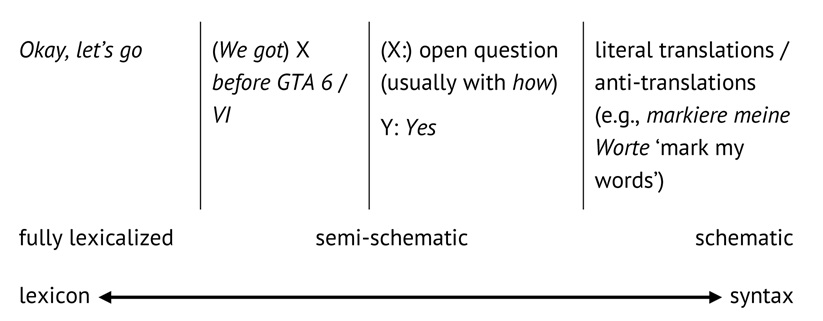
Figure 1: Text-memes with varying degrees of schematicity along the lexicon-syntax continuum
The present study, however, focuses exclusively on those text-memes that combine lexically fixed elements with variable slots. The theoretical and methodological challenges involved in their analysis are outlined in the following section.
3.2 Theoretical and methodological challenges
The analysis of digital communicative practices poses several challenges for constructional approaches. One source of complexity lies in the multimodal nature of much digitally mediated communication, which affects the formal side of constructions. In many cases, conventionalized constructional elements are not exclusively linguistic, for instance, in image macros, although this initially appears less problematic for text-memes. However, even purely verbal constructions frequently co-occur with images or emojis in digital contexts (Merten 2026a). While such elements may not be a part of the conventionalized form side, they nonetheless need to be taken into account when analyzing patterns of use.[9]
With regard to the formal description of text-memes, their structural variability presents a further challenge. This variability is not limited to open slots and their preferred fillers, but also manifests itself in the diversity of the syntactic structure in digital discourse, including shortened, expanded, or lexically divergent realizations of a given construction (e.g., We got GTA 6 / VI before X vs. Got GTA 6 / VI before). In many cases, it is difficult to draw a clear distinction between systematic structural variation and creative modification of an established pattern. Particularly in digital interaction, playful adaptations of conventionalized forms are crucial for generating humor, differentiating oneself from others, and avoiding the mere reproduction of viral trends. A key analytical question, therefore, concerns which lexical elements can be considered integral parts of the construction and how far its variability and slot structure extend. Moreover, repeated modification itself can lead to increasingly schematic patterns, as lexically specific expressions evolve into constructions with open slots (Hartmann/Ungerer 2024; Stumpf 2025). This dynamic dimension must be taken into account in the analysis.
Further challenges arise with regard to the meaning of constructions. The analysis must do justice to the play with vagueness, ambiguity, and implicature that is characteristic of many forms of digital communication, for instance in the form of intertextual references. A central question concerns which functional aspects are part of the constructional meaning and which are better understood as context-dependent effects; ultimately, this distinction can only be established on the basis of systematic, data-driven analysis of the respective text-meme (Merten/Stumpf 2026a). More generally, it is important to recognize that constructions in digital contexts often serve, from a socio-communicative perspective, to create shared humor and signal group membership. In this sense, they are associated with particular registers and display considerable indexical potential. This becomes evident, among other things, in metapragmatic comments that explicitly refer to the use of text-memes, evaluating them, for example, as particularly creative or, conversely, as formulaic and lacking in innovation.
Significant challenges also arise with regard to the collection of data on text-memes, that is, the identification and compilation of concrete instantiations of a construction (so-called ‘constructs’). These difficulties stem primarily from the embedding of text-memes in digital environments and from their semi-schematic nature. Text-memes circulate across a range of social media platforms, each characterized by its own technological affordances and interactional dynamics. As a result, compiling a comprehensive dataset ideally requires cross-platform data collection. However, corpus-based research faces two major obstacles in this regard. First, there is a lack of widely available, large-scale corpora representing contemporary social media communication (e.g., TikTok or Instagram). For German, a few exceptions include the Mobile Communication Database 2 (MoCoDa 2) (Beißwenger et al. 2019), the Nottingham YouTube Corpus (NottDeuYTSch) (Cotgrove 2023), and the Reddit-d corpus of the DWDS[10], which comprises discussion forums from the Reddit platform.[11] These resources are, however, either relatively small in size (e.g., MoCoDa 2: 320,501 tokens, 03/25/2026) and/or do not adequately reflect recent language use on social media (NottDeuYTSch: 2008–2018; Reddit-d: 2006–2023). Both aspects are crucial for the analysis of text-memes. On the one hand, text-memes—similar to idioms—tend to be relatively low-frequency phenomena, which makes large corpora essential for identifying a sufficient number of constructs. On the other hand, their study is primarily concerned with emergent and currently conventionalizing expressions, rather than with forms that were prevalent in earlier stages of digital communication (although a micro-diachronic perspective may well be of interest in its own right). For instance, none of the corpora mentioned above contain instantiations of the GTA 6 text-meme, not even the German-language Reddit-d corpus, whose most recent data is from 2023. Since the construction itself only emerged in 2023, however, this absence is not particularly surprising (see Chapter 3.4.1).
A further challenge relates to the semi-schematic status of text-memes. This poses difficulties for the formulation of search queries and, consequently, for the retrieval of relevant attestations. The more schematic a text-meme is, and the fewer lexical (autosemantic) elements and the greater the proportion of functional (synsemantic) elements it contains (see Figure 1), the more difficult it becomes to design search queries that retrieve as many relevant instances as possible while minimizing false positives. In the case of the Yes construction discussed by Stumpf (2024) and Merten/Stumpf (2026a), for example, the response particle yes (German ja) serves as the only lexical anchor. Automated searches based on this anchor inevitably yield a large number of irrelevant results. It should also be noted that text-memes are frequently embedded in images or videos (e.g., reels or stories), with the textual component superimposed on visual material, even though the visual element is not part of the conventionalized form of the construction. Such instances are difficult to retrieve automatically, not least because most available corpora are text-based and do not include visual data.
3.3 Data collection and methodological approach: how we can collect text-memes
Against this backdrop, the question arises as to how data on text-memes can be systematically compiled in order to enable their investigation on a broader empirical basis. If no instances of a given construction can be found in accessible corpora, one possible strategy is to compile dedicated, large-scale social media datasets in which the target text-meme can be systematically searched. However, in the absence of programming skills or expertise in computational linguistics required for building and processing such corpora, an alternative approach that is well established in Internet-pragmatic research presents itself: Following what has been described in media linguistics as a “roam around” approach (Androutsopoulos 2013: 241) or “guerilla ethnography” (Giaxoglou 2020: 65), researchers can identify and collect individual instantiations manually and compile them in structured lists (e.g., spreadsheets) including metadata (platform, date, etc.). This entails a sustained and targeted search for constructs across relevant platforms, promising user profiles and channels, comment sections, videos, and other communicative environments, potentially over an extended period of time and, where appropriate, in collaborative settings or with the assistance of student researchers. In this sense, the procedure resembles a form of snowball sampling, in which platform algorithms may actively support the process by surfacing related content that is likely to be representative of the usage of the text-meme under investigation. Searching for hashtags can also be very useful (Zappavigna 2018). For example, when looking at the GTA 6 text-meme, you can search for #GTAVI, #GTAMeme, and #xvorGTA6. Previous studies show that even a relatively small dataset of approximately 100–200 instances can provide instructive insights into the structure, functions, and usage of text-memes (Stumpf 2024; Merten/Stumpf 2026a). In this context, questions of data preparation also arise with respect to contextual embedding, in particular how preceding posts and subsequent responses can be taken into account. Closely related to this is the issue of mediality and searchability, since text-memes may occur in different formats (e.g., as standalone text, embedded in images, or integrated into video-based communication), which directly affects their inclusion in datasets. These challenges resonate with ongoing methodological debates in media linguistics concerning the adequacy of traditional corpus approaches in capturing contemporary digital communication practices.
As a complementary strategy, a crowdsourcing approach can be employed to support data collection.[12] In its simplest form, participants can submit examples via email; more effectively, however, contributions can be gathered through a dedicated online platform or app. This allows contributors, for example, students, to document authentic instances of text-memes encountered in their everyday social media use. A key advantage of this approach lies in the diversification of the data base: rather than relying solely on the researcher’s own online practices (i.e., their individual “roam around”), data collection is distributed across a larger number of participants. This helps to mitigate individual bias and broadens the empirical scope of the dataset. At the same time, it enables coverage of platforms, channels, and user communities that may fall outside the researcher’s habitual media repertoire. In my own work, involving students from seminar courses has proven particularly effective. Beyond increasing the quantity and diversity of the data, this strategy also helps to counteract potential age-related bias.[13] Moreover, students are not only valuable contributors when it comes to collecting instances of pre-selected text-memes; they often also bring attention to emerging constructions that are only just gaining traction and might otherwise escape the researcher’s notice.[14]
Online surveys can likewise serve as a valuable complement to the data collection process.[15] On the one hand, they make it possible to elicit additional text-memes, including those that may only be in the early stages of conventionalization. On the other hand, surveys allow for more targeted inquiry into specific text-memes, for instance, whether respondents are familiar with them, whether and how frequently they use them, on which platforms they occur, whether they also appear outside digital environments, and how their usage is evaluated. By incorporating respondents’ metadata (e.g., age, patterns of media consumption), it becomes possible to move beyond the analysis of individual corpus attestations and to generate insights into both inter- and intra-individual knowledge and usage of text-memes. This, in turn, enables more nuanced observations: certain constructions may prove to be more prevalent among particular age groups, while others may be closely associated with specific social media platforms or communicative contexts, thus exhibiting register-specific characteristics.
The resulting dataset can then be annotated along a range of formal, semantic, and pragmatic dimensions. These may include, for instance, the syntactic structure of the construction, the morphosyntactic and lexical realization of its open slot(s), its more abstract or generalized meaning, the semantics of the slot fillers, as well as its communicative functions and preferred contexts of use. In addition, metapragmatic stances towards the construction can be documented, that is, instances in which users explicitly evaluate or comment on the use of the text-meme, either positively or negatively. Such evaluations provide valuable insights into the degree of awareness, acceptance, or rejection of the construction within the relevant community of practice.
3.4 Potentials of combining Internet Pragmatics and Construction Grammar: insights from the GTA 6 text-meme
The following section illustrates the analytical potential of combining Internet Pragmatics with Construction Grammar, using the GTA 6 text-meme as a case in point. The aim is not to provide a systematic empirical account of the construction; rather, the discussion seeks to highlight, through selective, authentic examples, the extent to which text-memes constitute a particularly instructive object of analysis for an Internet-pragmatically informed constructional approach. The analysis is based on a dataset of 239 instances of the construction, collected in spring 2026 from a range of social media platforms using the “roam around” method outlined in Section 3.3.[16] The majority of the data derives from Tumblr (n = 137), Reddit (n = 63), and YouTube (n = 25), supplemented by a smaller number of examples from Facebook, Instagram, TikTok, and Twitch. The dataset comprises 145 English-language instances and 93 German-language instances, alongside a single example in Serbian. Based on this data, I would like to discuss various perspectives that demonstrate both the added value of a constructional approach to Internet Pragmatics and of an Internet-pragmatic approach to Construction Grammar.
3.4.1 Origin, cultural embedding, and diffusion
The emergence of the GTA 6 text-meme is embedded in a broader pop-cultural context, namely the Grand Theft Auto (GTA) video game franchise, a series that revolves around a life of crime in an open-world setting. The game series is closely intertwined with pop culture, as the games deliberately reference iconic films, music, and social trends, often in a satirical manner. GTA is thus perceived not only as a video game but also as a cultural medium. The GTA series is also known for its exceptionally long release intervals, which have given rise to their very own narratives and memes within the gaming community.[17] Ultimately, the immediate trigger for the GTA 6 text-meme is the prolonged wait and the resulting anticipation surrounding the sequel to the hugely successful fifth installment from 2013. What started as an inside running gag in gaming forums eventually spread to social media platforms that had nothing to do with video games. This cross-platform diffusion illustrates the increasingly ubiquitous and decentralized nature of contemporary media communication, a central concern of current media-linguistic research.
It is generally very difficult to pinpoint exactly what the first documented instance of a text-meme is. According to my research, the GTA 6 text-meme is likely to go viral around mid-2023. Since then, users have been employing this pattern in various contexts to express their surprise and disbelief that—sometimes highly improbable—global events, technological developments, or other unique and curious occurrences have already taken place or might even happen before Grand Theft Auto VI is released. According to knowyourmeme.com, the viral trend originated from a TikTok video posted on 27 July 2023 by the user @jadendunn, jokingly stating We got aliens before GTA 6.[18] The joke was reposted on the same day, and other users quickly began adopting it as an analogical template. In this way, the pattern [(We got) X before GTA 6 / VI] disseminated through recontextualization across multiple platforms and became conventionalized. Notably, the pattern is doubly embedded in the digital sphere: it originates in social media communication and simultaneously refers to a quintessentially digital cultural artifact, namely a video game (however, importantly, without its use being limited to this narrow context).
Text-memes represent a particularly fruitful domain for diachronic Internet linguistics. Given that an identifiable point of origin can be established, they display similarities to so-called snowclones (Hartmann/Ungerer 2024: 628). Snowclones are partially schematic constructions that arise through the recurrent lexical substitution of a culturally salient source construction (comparable to “winged words” in phraseology) and display a certain degree of productivity alongside distinctive formal and/or functional features indicative of linguistic innovation (Hartmann/Ungerer 2024: 605). From this perspective, it is instructive to investigate the etymology and emergence of as well as processes of change affecting text-memes, that is, their micro-diachrony, which in digital contexts is likely characterized by a certain degree of rapid turnover compared to more traditional diachronic approaches in Construction Grammar that typically operate on much longer time spans of development. Such an approach enables insights into the digitally mediated pathways of diffusion and the communicative practices through which new lexico-grammatical patterns spread. These insights are of relevance to both Internet Pragmatics and Construction Grammar, particularly in relation to processes of constructionalization (Traugott/Trousdale 2013: 183–186). Accordingly, the study of the birth and propagation of text-memes can also be situated within recent research on lexico-grammatical and phraseological neologisms (Villers [ed.] 2024), which often “stem from social media platforms such as Twitter, Instagram, or TikTok” (Villers 2024: 2).
As might be expected, many text-memes originate in English. What is particularly noteworthy, however, is that they are typically translated into the target language, in the present case, German. Such lexico-grammatical borrowings are a common feature of digital communication and can be observed across a wide range of linguistic resources (Androutsopoulos 2012; Dailey-O’Cain 2017; Merten 2026b). Translated text-memes carry sociocultural significance insofar as their use indexes membership in a community of digitally literate users. They signal familiarity with the Anglo-American pop-cultural context in which the meme originated. From the perspective of borrowing and loanword research, especially when combined with an interest in the sociocultural motivations underlying their use, text-memes thus represent an exciting subject of study.
3.4.2 Constructional properties: form and meaning between fixedness and variation
From an Internet-pragmatic perspective, text-memes can be understood not merely as a form of “Internet slang”[19], that is, as a communicative practice specific to digital interaction, but also as conventionalized form-meaning pairings in the sense of Construction Grammar. The pattern (We got) X before GTA 6 / VI (or its German counterpart (Wir haben) X vor GTA 6 / VI) thus constitutes a partially schematic construction whose open slot can be filled with a wide range of content, enabling speakers to draw humorous comparisons. Structurally, the text-meme can occur either in a fully specified clausal format, featuring the pronominal subject we and the verb got (Example 1), or in a reduced, elliptical variant in which these elements are omitted (Example 3). The full form may either be translated in its entirety from English (Example 4) or, alternatively, occur in German in a similarly reduced, elliptical variant (Example 2).
(3) pokemon z before gta 6
(Post on Tumblr)
(4) Wir haben Dönerpreise über 10€ bevor GTA 6, markiere meine Worte (‘We got kebab prices over €10 before GTA 6, mark my words’)
(Comment on Reddit under the post “ich🥲iel”)
The verb may also vary. For example, there are instances using have (Example 5) or bekommen in German (Example 6), but occasionally also with other verbs, as in Examples 7 and 8 (English) and 9 (German). We can therefore conclude that there is indeed a certain degree of variability in terms of structure. In addition to a longer and a shorter form, there is also variation in the choice of verb, not to mention the use of Arabic or Roman numerals.
(5) we have rhaenyra and mysaria making out before gta 6
(Post on Tumblr)
(6) Wir bekommen Bayern-Update vor GTA 6 (‘We’re getting a Bayern update before GTA 6’)
(Comment on Reddit under the post “Söder verspricht “Bayern-Update”” [‘Söder promises “Bayern update”’])
(7) We’ve found the location of the real backrooms before GTA 6.
(Post on Tumblr)
(8) can’t believe I’m turning 25 before GTA 6
(Post on Tumblr)
(9) Markus Söder ist Dönermann vor GTA 6 (‘Markus Söder is a kebab seller before GTA 6’)
(Comment on Reddit under the post “Kaum zu glauben: Bekannter Food-Influencer ist im Nebenjob auch noch bayerischer Politiker” [‘Hard to believe: A well-known food influencer also works part-time as a Bavarian politician’])
Such structural deviations from the canonical form are typically described in phraseological research as occasional modifications and, more recently within Construction Grammar, as instances at the intersection of E-creativity (enlarging/extending), as opposed to F-creativity (fixed) (Sampson 2016; Bergs 2018; Hoffmann 2022).[20] This raises the broader question of the extent to which digital communication environments allow for increased variability in the formal realization of partially schematic patterns. In the present case, the only clearly stable element appears to be the prepositional phrase before GTA 6 / VI, in German vor GTA 6 / VI, alongside the obligatory X-slot, whose fillers are construed in a (primarily temporal) relation to this anchor. It is likely, however, that even the abbreviated form GTA 6 / VI alone suffices to evoke the construction among members of the relevant digital community. In this sense, the abbreviation functions as a cue that activates a shared frame, one that encapsulates the prolonged anticipation surrounding the release of the next installment of the video game.
We see inversions in the data where GTA 6 / VI fills the X-slot while another element appears in the prepositional phrase (Examples 10 and 11). This structure can be classified as an instance of E-creativity, as it deviates from the conventionalized structure of the text-meme (Hoffmann 2022: 266). On the other hand, however, this inversion also appears to occur repeatedly (n = 12) and, given its frequency, may in fact be emerging as a variant in its own right. Either way: in such cases, the occurrence of an event is hyperbolically framed as taking even longer than the release of the video game sequel. This structure thus involves an even greater intensification than the conventional form of the construction.
(10) At this rate, we’ll get GTA6 before a new season of Stranger Things
(Post on Tumblr)
(11) Wir bekommen „GTA VI“ vor Stuttgart 21. (‘We’ll get “GTA VI” before Stuttgart 21.’)
(Comment on Reddit under the post “Probleme bei der Digitalisierung – Stuttgart 21: Tiefbahnhof wird laut Insidern später fertig” [‘Challenges in the digitalization process—Stuttgart 21: According to insiders, the underground station will be completed later than planned’])
Even more divergent from the conventionalized text-meme are instances in which the abbreviation GTA 6 / VI is no longer present at all (Examples 12 and 13). Such cases can be interpreted as evidence of ongoing snowcloning (Hartmann/Ungerer 2024), whereby repeated creative adaptations gradually give rise to (more) schematic, grammatical patterns derived from initially (more) lexicalized expressions (Stumpf 2025). In this development, the construction (We got) X before GTA 6 / VI is generalized into a more abstract schema (We got) X before Y. Similar to GTA 6 / VI, the Y-slot is filled by an event that a particular community has been awaiting for an extended period of time, thereby inheriting the semantic and pragmatic properties associated with the source construction. These instances are particularly revealing, as they show that the pattern remains recognizable and functionally operative even in the absence of its original lexical anchor. The initial construction thus continues to serve as an analogical model, underpinning further extensions despite its formal reduction.[21]
(12) we got pokemon animal crossing before new horizons successor
(Post on Tumblr)
(13) we got lando norris downfall before acotar 5
(Post on Tumblr)
The construction has a holistic meaning that is symbolically linked to its partially lexicalized form. Regardless of how the X-slot is filled, the construction evokes this meaning, thereby emphasizing its status as a conventionalized unit. In current usage, the literal anticipation of the game itself has largely receded into the background. Instead, the text-meme serves as a more general expressive resource for commenting on delay, deferred occurrence, and the expectations surrounding a given event, often extending well beyond the domain of video games. The as-yet unreleased game functions as a temporal reference point against which other events are evaluated. At the same time, the construction can foreground a sense of surprise, shifting the emphasis from prolonged waiting to the perceived improbability or unexpectedness of event X. These two semantic dimensions, delay and surprise, are not mutually exclusive but frequently co-occur in actual usage.
Semi-schematic text-memes such as the one discussed here are particularly interesting for studies in Construction Grammar because their form includes both fixed lexical components and syntactic slots. Hence, this provides empirical support for the assumption that lexicon and grammar are not two separate modules but rather that they form a continuum. Furthermore, such text-memes exhibit extremely high productivity (considering the ratios of types, tokens, and hapax legomena). While analyses of common constructional idioms (Mollica/Stumpf 2022; Ivorra-Ordines 2026) typically reveal slot fillers that are preferred and are thus more firmly established than other slot fillers—and may even constitute micro-constructions in the sense of Traugott (2008: 236)—my data almost exclusively contain hapax legomena in the X-position. Filling the slot in an individually creative way is thus important for users seeking to position themselves prominently in the competition for digital attention, reflecting what Haspelmath (1999: 1055) terms linguistic extravagance, where speakers favor marked or innovative forms to stand out and get noticed. Moreover, the GTA 6 text-meme typically occurs as a standalone comment post and is rarely embedded within longer textual contributions, which further contributes to its markedness and visual salience, as is also the case with other text-memes previously investigated (Stumpf 2024; Merten/Stumpf 2026a).
3.4.3 Stance, social meaning, and community practices
In digital discourse, the GTA 6 text-meme functions as a conventionalized and entrenched linguistic template through which users articulate ironic or resigned commentary on pop-cultural developments and broader societal trends. It thus operates not merely as a humorous device for expressing impatience, but can more generally—following Merten (2025)—be analyzed as a stance construction. The use of the GTA 6 text-meme, in particular, allows speakers to position themselves vis-à-vis specific events or developments, by indexing evaluative, often affectively charged stances toward what is being commented on. As is typical of digital commenting practices, such evaluations may be accompanied by emojis that indicate positive or negative affective stances (Examples 14 and 15).
(14) We got Roberto Baggio mentioned from Randy Orton before GTA VI 🤩
(Post on Tumblr)
(15) We got sex 2 before GTA 6 🤦♀️
(Post on Tumblr)
What is particularly noteworthy in this context is that stance-taking in digital environments is not merely a communicative-pragmatic phenomenon; rather, users can draw on conventionalized lexico-grammatical patterns such as text-memes to position themselves. In other words, while stance-taking is inherently pragmatic in nature, it is routinely “packaged” in recurrent constructions that provide ready-made form-meaning pairings. These constructions offer cognitive relief, as speakers do not need to formulate novel expressions each time they wish to evaluate a given state of affairs. At the same time, they carry an important social dimension: their use indexes membership in a community whose members are familiar not only with the construction itself but, ideally, also with its underlying cultural and discursive origins (in this case, the context surrounding the video game).
Consequently, the use of such constructions presupposes a form of practices-based knowledge, i.e., what may be described as Digital Literacies (Jones/Hafner 2021) or, more specifically in the case of text-memes, Digital Grammar Literacies (Merten/Stumpf 2026b). Users must command not only the formal and functional properties of the construction, but also the conditions of its appropriate use, including communicative intentions, platform-specific norms, the expectations of particular audiences, and contextual embedding (e.g., the responsiveness of the construction). Following Leclercq/Morin (2025: 43), who recently proposed an expansion of the meaning side of constructions, the aspects mentioned can be described as “social meaning”. In line with Leclercq/Morin’s (2025: 44) distinction, the GTA 6 text-meme can be said to carry both interactional social meaning, by indexing a specific register, genre, and activity type of digitally mediated humor, and sociocultural social meaning, as its use signals affiliation with digitally literate communities familiar with the meme’s pop-cultural origin and circulation.[22] This social dimension can be considered a defining characteristic of text-memes more generally.
3.4.4 Metapragmatics, metadiscourse, and the online-offline nexus
Particularly instructive are instances where other users comment on the use of text-memes, revealing metapragmatic positioning. On the one hand, users may simply find the text-meme unfunny (for example, someone writes under the YouTube comment in Example 1: the joke aint funny and never was). On the other hand, it can be observed that the excessive use of the GTA 6 text-meme has led to posts relying on this construction being perceived as unoriginal. In Example 16, User 2 criticizes the use of the text-meme by highlighting its clichéd character. User 3 takes up this critical stance, inserts it into the X-slot of the GTA 6 pattern, and thereby foregrounds the emerging tendency for even criticism of the GTA 6 meme itself to circulate within the discourse prior to the game’s actual release, which he apparently finds very funny, as indicated by the two laughing emojis. This reflexive reuse not only reinforces the evaluative stance but also contributes to the meme’s status as a shared, socially recognizable resource within the online community.
(16) User 1: Olaf Scholz bei World Wide Wohnzimmer vor GTA 6 😭
(‘Olaf Scholz on World Wide Wohnzimmer before GTA 6 😭’)
User 2: Der Spruch ist ausgelutscht, aber soooo wahr.
(‘The saying is overused, but soooo true.’)
User 3: „der Spruch ist so ausgelutscht“ Spruch vor GTA 6😂😂
(‘“The saying is overused” saying before GTA 6 😂😂’)
(Metapragmatic stances on the use of the GTA 6 text-meme in a comment under the YouTube video “OLAF SCHOLZ über Fehler, Aliens, Dönerpreisbremse und warum er Kanzler bleiben will | TALK” [‘OLAF SCHOLZ on mistakes, aliens, the kebab price cap, and why he wants to remain chancellor | TALK’])
Example 17 operates on an even higher meta-level, where the uptake of the previous stance, again articulated through the text-meme, is itself evaluated, as it points to the perceived continuation of this practice for another year (noch ein Jahr) following yet another delay of the game’s release date announced in the post to which the comment responds.
(17) Noch ein Jahr „vor GTA 6“ Sprüche vor GTA 6 vor GTA 6 (‘Another year of “before GTA 6” sayings before GTA 6 before GTA 6’)
(Comment on Reddit under the post ““GTA 6” auf 2026 verschoben” [‘“GTA 6” delayed until 2026’])
By this point evaluative positioning on the use of the GTA 6 text-meme has become routine and is sometimes even perceived as formulaic. In other words, this metapragmatic criticism has itself undergone a process of memetic conventionalization. This dynamic is succinctly captured in a Reddit thread, where one user explicitly formulates this observation accompanied by an image macro meme; while some respondents dismiss the post as unfunny, others explicitly endorse the assessment (Example 18).
(18) Wir haben ein Meme, das darüber spricht, wie nervig und unlustig „Wir hatten ___ bevor GTA 6“ vor GTA 6 ist. (‘We have a meme that talks about how annoying and unfunny “We had ___ before GTA 6” is before GTA 6.’)

Dass dieses Meme verschwindet, ist einer der Hauptgründe, warum ich mich auf GTA VI freue. (‘The fact that this meme is going away is one of the main reasons I’m looking forward to GTA VI.’)
Ich halte es nicht mehr aus 💪🏼🔥 (‘I can’t take it anymore 💪🏼🔥’)
Ich schwöre, jeder Top-Kommentar auf YouTube ist so ein Müll. Da gibt es „auf einem toten Pferd herumreiten“, und dann gibt es das, was vor GTA verdammten VI passiert ist. (‘I swear, every top comment on YouTube is total garbage. There’s “beating a dead horse”, and then there’s what happened before GTA damn VI.’)
(Reddit post and agreeing comments)
To sum up: What once functioned as an innovative communicative resource for demonstrating one’s familiarity with digital commenting practices is now subject to devaluation: through repeated use, extravagance gives way to conformity (Haspelmath 1999: 1057). These examples not only illustrate the ephemeral nature of digitally established communicative resources, but also underscore the potential of follow-up communication for metapragmatic analysis, an analytical perspective that has so far received little attention in Construction Grammar.
Evidence that constructions originating in digital communities can become highly conventionalized—and may even have already passed their “expiration date”—is provided by the fact that they gain recognition beyond their initial online environments. The GTA 6 text-meme, for instance, has generated a broader metadiscourse, as reflected in numerous (often journalistic) pieces that explicate and contextualize the pattern for a wider audience (see the following articles).
Sogar Oasis und die Beatles sind zurück – was alles vor „GTA VI“ passierte[23]
(‘Even Oasis and the Beatles are back—everything that happened before “GTA VI”’)
(Der Spiegel, 01/16/2025)
Warten auf „Grand Theft Auto 6“[24]
(‘Waiting for “Grand Theft Auto 6”’)
(Süddeutsche Zeitung, 11/07/2025)
GTA VI wird verschoben – so reagiert das Netz[25]
(‘GTA VI has been delayed—here’s how the internet is reacting’)
(Schweizer Radio und Fernsehen [SNF], 11/10/2025)
The use of text-memes once again demonstrates that the notion of communication spaces as being exclusively digital or purely analog hardly reflects communicative reality (Merten/Stumpf 2026a). Although the GTA 6 text-meme is strongly tied to digital contexts, constituting a form of social meaning in the sense of Leclercq/Morin (2025), it is no longer confined to online communication. Example 19 shows the construction on a protest sign in Serbia, that is, in an offline context, even though attention was brought to this instance of use via the Internet, specifically through Reddit.
(19)
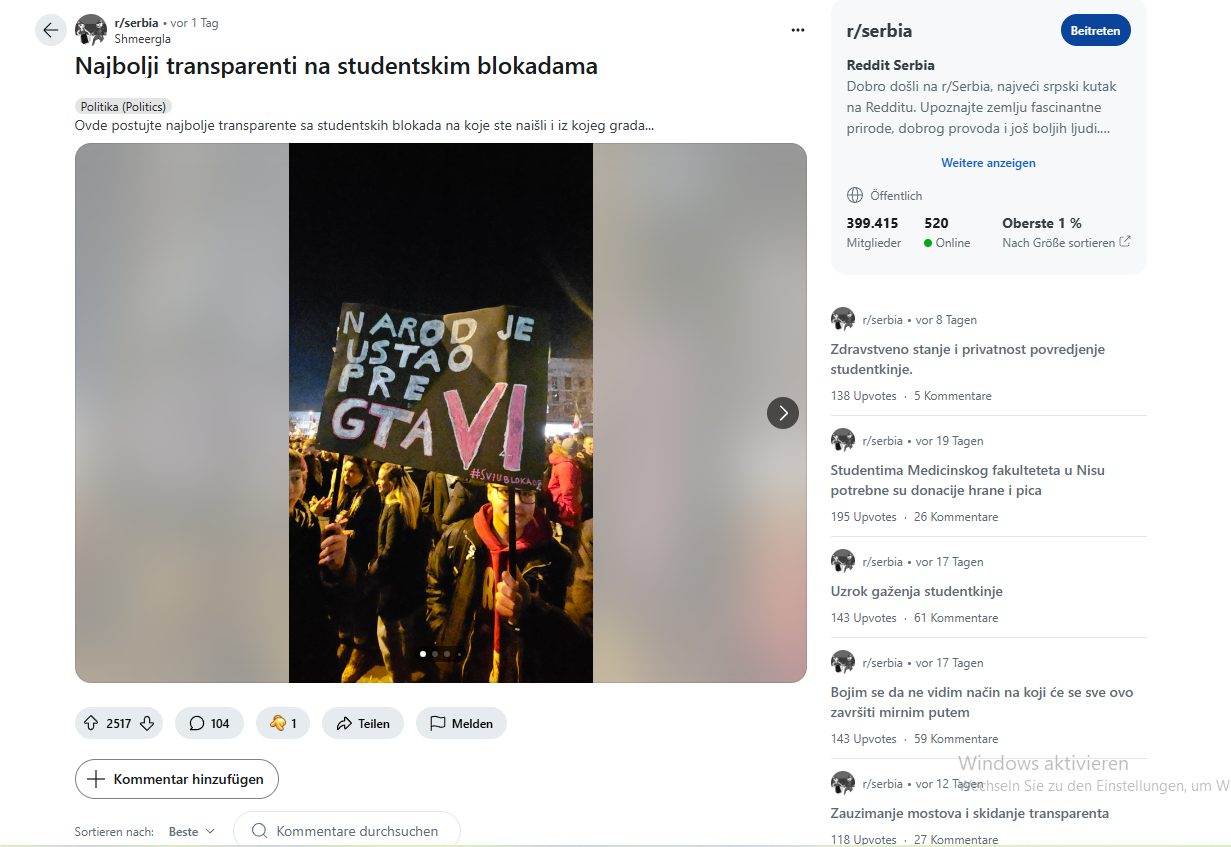
(GTA 6 text-meme on a protest sign in Serbia, posted on Reddit: Narod je ustao pre GTA VI [‘The people have risen before GTA VI’])
Example 19 illustrates the so-called ‘online-offline nexus’ (Blommaert/Maly 2019: 3), grounded in “trajectories of sign mobility across physical and mediational spaces” (Androutsopoulos 2024: 445). It thus points to the medial mobility of constructions, which can be understood as a process of recontextualization. A construction originating in a specific communicative context becomes embedded in ever-changing contexts through recontextualization (Androutsopoulos 2016: 338). In this way, the analysis of text-meme constructions highlights that digitality and analogicity should not be understood as a strict dichotomy, but rather as intertwined and mutually constitutive dimensions of communication. Such cases directly speak to current media-linguistic discussions on the dissolution of clear boundaries between online and offline communication, as foregrounded in recent debates on the ubiquity of media practices.
4 Conclusion and outlook
This paper has explored the potential of combining Internet Pragmatics and usage-based Construction Grammar through the case of the GTA 6 text-meme. From a theoretical perspective, digitally mediated communication raises fundamental questions for constructionist approaches: To what extent does the digital environment shape the emergence, diffusion, and use of constructions? Do constructions in online settings differ from those found in more traditional written or spoken discourse? And how can the specific affordances of digital communication be adequately integrated into a usage-based model of grammar?
The analysis of the GTA 6 text-meme suggests that such questions are not merely peripheral but touch upon core assumptions of Construction Grammar. Despite its relatively short lifespan—and, as the community itself suggests, its rapid “expiration date”[26]—the construction provides a particularly instructive case of how new lexico-grammatical patterns emerge, stabilize, and become socially meaningful within online discourse. It demonstrates that even highly variable, semi-schematic structures can develop into recognizable and conventionalized form-meaning pairings. Variability and conventionalization thus do not stand in opposition but jointly contribute to the construction’s communicative functionality.
At the same time, the analysis highlights several dimensions that are especially salient in digitally embedded constructions: their micro-diachronic development and rapid diffusion across platforms; their role in the creation of shared humor and the signaling of group membership; their susceptibility to recontextualization across communicative settings, including movement across online and offline contexts; and their embedding in metapragmatic discourse, where their use, overuse, and perceived clichéd character become objects of negotiation. Closely related to this is the observation that such constructions often give rise to numerous creative modifications, driven by an apparent pressure to distance oneself from the conventionalized pattern through increasingly marked or exaggerated variations in order to achieve visibility and show originality.
These observations underscore the importance of the “social meaning” of constructions in the sense of Leclercq/Morin (2025). Text-meme constructions are not only cognitive pairings of form and meaning but also socially indexical resources that position speakers within communities of practice. In this regard, an Internet-pragmatically informed Construction Grammar aligns closely with approaches such as Digital Grammar Studies and Social Construction Grammar, and can be situated within the emerging framework of Construction Pragmatics, which systematically integrates interactional and sociocultural dimensions into the analysis of constructions.
Finally, the GTA 6 construction is by no means an isolated phenomenon. A wide range of text-meme constructions, such as hold my beer, nobody / no one, me […] also me, tell me without telling me, or living in your head rent free, demonstrate that such patterns constitute a pervasive and productive domain of contemporary online communication. Future research should therefore move beyond single case studies and aim at a more systematic account of text-memes as a central object of Internet-pragmatic Construction Grammar. In doing so, it not only refines our understanding of constructional variation, change, and creativity, but also contributes to a more comprehensive theory of language use in digitally mediated communication practices. In light of the questions raised in this Special Issue on the future of media linguistics, the analysis argues for a stronger analytical focus on recurrent linguistic structures in digitally mediated communication alongside established pragmatic and interactional perspectives.
References
Ädel, Annelie (2021): Reflections on Reflexivity in Digital Communication: Towards a Third Wave of Metadiscourse Studies. In: D’Angelo, Larissa/Mauranen, Anna/Maci, Stefania (eds.): Metadiscourse in Digital Communication. New Research, Approaches and Methodologies. Cham: Palgrave Macmillan, 37–64.
DOI: 10.1007/978-3-030-85814-8_3
Albert, Georg (2026): Mediensensitive Gebrauchsnormen. Überlegungen zur systematischen Verortung typischer Phänomene digitaler Schriftlichkeit. In: Merten, Marie/Stumpf, Sören (eds.): Digital Grammar Studies. Grammatische Muster in der digitalen Kommunikation. Berlin/Boston: De Gruyter (Formelhafte Sprache / Formulaic Language, 9), 19–42.
DOI: 10.1515/9783112237007-002
Androutsopoulos, Jannis (2012): English ‘on top’: discourse functions of English resources in the German mediascape. In: Sociolinguistic Studies 6 (2), 209–238.
Androutsopoulos, Jannis (2013): Online Data Collection. In: Mallinson, Christine/Childs, Becky/Van Herk, Gerard (eds.): Data Collection in Sociolinguistics. Methods and Applications. New York/London: Routledge, 236–249.
Androutsopoulos, Jannis (2016): Mediatisierte Praktiken: Zur Rekontextualisierung von Anschlusskommunikation in den Sozialen Medien. In: Deppermann, Arnulf/Feilke, Helmuth/Linke, Angelika (eds.): Sprachliche und kommunikative Praktiken. Berlin/Boston: De Gruyter, 337–367.
DOI: 10.1515/9783110451542-014
Androutsopoulos, Jannis (2024): The Offline–Online Nexus. In: Blackwood, Robert/Tufi, Stefania/Amos, Will (eds.): The Bloomsbury Handbook of Linguistic Landscapes. London: Bloomsbury, 441–455.
Beißwenger, Michael/Imo, Wolfgang/Fladrich, Marcel/Ziegler, Evelyn (2019): https://www.mocoda2.de: a database and web-based editing environment for collecting and refining a corpus of mobile messaging interactions. In: European Journal of Applied Linguistics 7 (2), 333–344.
Bergs, Alexander (2018): Learn the Rules like a Pro, so you can Break them like an Artist (Picasso): Linguistic Aberrancy from a Constructional Perspective. In: Zeitschrift für Anglistik und Amerikanistik 66 (3), 277–293.
Blommaert, Jan/Maly, Ico (2019): Invisible Lines in the Online-Offline Linguistic Landscape. In: Tilburg Papers in Culture Studies 223, 1–11.
Boas, Hans C. (2013): Cognitive Construction Grammar. In: Hoffmann, Thomas/Trousdale, Graeme (eds.): The Oxford Handbook of Construction Grammar. Oxford: Oxford University Press, 233–252.
DOI: 10.1093/oxfordhb/9780195396683.013.0013
Booij, Geert (2002): Constructional idioms, morphology, and the Dutch lexicon. In: Journal of Germanic Linguistics 14 (4), 301–329.
DOI: 10.1017/S1470542702000168
Bücker, Jörg (2012): Sprachhandeln und Sprachwissen. Grammatische Konstruktionen im Spannungsfeld von Interaktion und Kognition. Berlin/Boston: De Gruyter (Sprache und Wissen, 11).
Bülow, Lars/Merten, Marie-Luis/Johann, Michael (2018): Internet-Memes als Zugang zu multimodalen Konstruktionen. In: Zeitschrift für Angewandte Linguistik 69, 1–32.
Cotgrove, Louis (2023): DAS NOTTDEUYTSCH-KORPUS: Ein Korpus deutschsprachiger YouTube-Kommentare. In: Korpora Deutsch als Fremdsprache 3 (2), 225–229.
DOI: 10.48694/kordaf.3841
Croft, William (2001): Radical Construction Grammar. Syntactic Theory in Typological Perspective. Oxford: Oxford University Press.
DOI: 10.1093/acprof:oso/9780198299554.001.0001
Dailey-O’Cain, Jennifer (2017): Trans-National English in Social Media Communities. London/New York: Palgrave Macmillan (Language and Globalization).
DOI: 10.1057/978-1-137-50615-3
Dancygier, Barbara/Vandelanotte, Lieven (2017): Internet memes as multimodal constructions. In: Cognitive Linguistics 28 (3), 565–598.
Dancygier, Barbara/Vandelanotte, Lieven (2025): The Language of Memes. Patterns of Meaning Across Image and Text. Cambridge: Cambridge University Press.
Darvin, Ron (2016): Language and identity in the digital age. In: Preece, Siân (ed.): The Routledge Handbook of Language and Identity. New York: Routledge, 523–540.
Du Bois, John W. (2007): The stance triangle. In: Englebretson, Robert (ed.): Stancetaking in Discourse. Subjectivity, evaluation, interaction. Amsterdam/Philadelphia: Benjamins (Pragmatics & Beyond New Series, 164), 139–182.
Fillmore, Charles/Kay, Paul/O’Connor, Mary Catherine (1988): Regularity and Idiomaticity in Grammatical Constructions. The Case of let alone. In: Language 64 (3), 501‒538.
DOI: 10.2307/414531
Giaxoglou, Korina (2020): A Narrative Approach to Social Media Mourning Small Stories and Affective Positioning. New York/London: Routledge (Routledge Research in Narrative, Interaction, and Discourse).
Gillmann, Melitta (2024): Allostructions and stancetaking: a corpus study of the German discourse management constructions Wo/wenn wir gerade/schon dabei sind. In: Cognitive Linguistics 35 (1), 67–107.
Goldberg, Adele E. (2006): Constructions at Work. The Nature of Generalization in Language. Oxford/New York: Oxford University Press.
DOI: 10.1093/acprof:oso/9780199268511.001.0001
Goldberg, Adele E./Herbst, Thomas (2021): The nice-of-you construction and its fragments. In: Linguistics 59 (1), 285–318.
Greene, Jacqueline Hirsh/Schmid, Hans-Jörg (2024): POV: me, an empath, sensing the linguistic urge … to study the forms and functions of text-memes. In: English Today 40, 97–104.
DOI: 10.1017/S0266078423000469
Hartmann, Stefan/Ungerer, Tobias (2024): Attack of the snowclones: A corpus-based analysis of extravagant formulaic patterns. In: Journal of Linguistics 60 (3), 599–634.
DOI: 10.1017/S0022226723000117
Haspelmath, Martin (1999): Why is grammaticalization irreversible? In: Linguistics 37 (6), 1043–1068.
Heitmayer, Maxi/Schimmelpfennig, Robin (2024): Netiquette as digital social norms. In: International Journal of Human-Computer Interaction 40 (13), 3334–3354.
DOI: 10.1080/10447318.2023.2188534
Herring, Susan C. (2012): Grammar and electronic communication. In: Chapelle, Carol A. (ed.): The Concise Encyclopedia of Applied Linguistics. Hoboken: Blackwell, 521–536.
DOI: 10.1002/9781405198431.wbeal0466.pub2
Hoffmann, Thomas (2022): Constructionist approaches to creativity. In: Yearbook of the German Cognitive Linguistics Association 10 (1), 259–284.
Imo, Wolfgang (2015): Nachträge im Spannungsfeld von Medialität, Situation und interaktionaler Funktion. In: Vinckel-Roisin, Hélène (ed.): Das Nachfeld im Deutschen. Theorie und Empirie. Berlin/Boston: De Gruyter (Reihe Germanistische Linguistik, 303), 231–253.
DOI: 10.1515/9783110419948-012
Ivorra-Ordines, Pedro (2026): Comparative constructional idioms in Spanish, English and French. A contrastive usage-based approach. Berlin/Boston: De Gruyter (Formelhafte Sprache / Formulaic Language, 8).
DOI: 10.1515/9783112249437
Jegede, Olusegun Oladele (2024): Speech Acts in the Digital Sphere: A Corpus-Based Exploration of Interactional Dynamics on Social Media Platforms. In: Corpus-based Studies across Humanities 2 (2), 359‒383.
Jones, Rodney H./Hafner, Christoph A. (2021): Understanding Digital Literacies: A Practical Introduction. 2nd edition. New York: Routledge.
Kiesling, Scott F./Pavalanathan, Umashanthi/Fitzpatrick, Jim/Han, Xiaochuang/Eisenstein, Jacob (2018): Interactional Stancetaking in Online Forums. In: Computational Linguistics 44 (4), 683‒718.
DOI: 10.1162/coli_a_00334
König, Katharina (2021): Stance taking with ‘laugh’ particles and emojis – Sequential and functional patterns of ‘laughter’ in a corpus of German WhatsApp chats. In: Journal of Pragmatics 142 (1), 156‒170.
DOI: 10.1016/j.pragma.2019.01.008
Leclercq, Benoît/Morin, Cameron (2025): The Meaning of Constructions. Cambridge: Cambridge University Press (Elements in Construction Grammar).
Lindström, Jan (2025): Constructions in Spoken Interaction. In: Fried, Mirjam/Nikiforidou, Kiki (eds.): The Cambridge Handbook of Construction Grammar. Cambridge: Cambridge University Press, 309–333.
DOI: 10.1017/9781009049139.013
Lou, Adrian (2017): Multimodal simile: The “when” meme in social media discourse. In: English Text Construction 10 (1), 106–131.
Matrood, Doaa Taher (2025): Language and Digital Identity: A Sociolinguistic Study of Online Communities. In: Frontiers in Global Research 1 (2), 1–3.
DOI: 10.55559/fgr.v1i2.1
Meier-Vieracker, Simon (2023): Memefication. Rekontextualisierung politischer Rede in digitalen Diskursen. In: Trost, Igor (ed.): Remotivierung. Von der Morphologie bis zur Pragmatik. Berlin/Boston: De Gruyter (Linguistik – Impulse und Tendenzen, 105), 215–244.
Meier-Vieracker, Simon (2026): Deutsche Messi – Überlegungen zu einem Mikrogenre des Kulturvergleichs. In: Schröter, Juliane/Pfäffle, Anna/Wibel, Adelheid (eds.): Kulturell konstruktiv. Sprachtheoretische Perspektiven der Kulturlinguistik. Berlin/Boston: De Gruyter (Linguistik – Impulse und Tendenzen, 117), 195–217.
Merten, Marie-Luis (2022): Ritualisierte Anschlusskommunikation auf Instagram. Formelhafte Komplimente und ihre Erwiderung als verdichtete Online-Interaktion. In: Deutsche Sprache 50 (4), 309–334.
DOI: 10.37307/j.1868-775X.2022.04.03
Merten, Marie-Luis (2024): Digitale Öffentlichkeit(en) metapragmatisch. Zur Aushandlung und Überschreitung kommunikativer Grenzen am Beispiel des Bodyshamings auf YouTube. In: Zeitschrift für germanistische Linguistik 52 (1), 65–94.
Merten, Marie-Luis (2025): Soziale Positionen – soziale Konstruktionen. Stancetaking im Online-Kommentieren. Berlin/Boston: De Gruyter (Formelhafte Sprache / Formulaic Language, 7).
Merten, Marie-Luis (2026a): Patterns of multimodal evaluation: How written language and emojis interact in Instagram comments. In: Arndt-Lappe, Sabine/Stumpf, Sören/Belosevic, Milena/Maurer, Peter/Moulin, Claudine/Rettinger, Achim (eds.): Patterns in Language and Communication. Between Theoretical Grounding and Empirical Methods. Berlin/Boston: De Gruyter (Interdisciplinary Linguistics, 5), 225–252.
DOI: 10.1515/9783111199740-009
Merten, Marie-Luis (2026b): Partikel-Konstruktionen im digitalen Schreiben. Gebrauchsmuster mit safe und fr auf TikTok. In: Merten, Marie-Luis/Stumpf, Sören (eds.): Digital Grammar Studies. Grammatische Muster in der digitalen Kommunikation. Berlin/Boston: De Gruyter (Formelhafte Sprache / Formulaic Language, 9), 45‒77.
DOI: 10.1515/9783112237007-003
Merten, Marie-Luis/Stumpf, Sören (2026a): Vom Internet-Meme zur lexikogrammatischen Konstruktion. Zur Karriere eines evaluativen Zeichenschemas zwischen Digitalität und Analogizität. In: Zeitschrift für Semiotik 47 (1–2), 89–116.
Merten, Marie-Luis/Stumpf, Sören (2026b): Digital Grammar Studies. Ein Programm. In: Merten, Marie-Luis/Stumpf, Sören (eds.): Digital Grammar Studies. Grammatische Muster in der digitalen Kommunikation. Berlin/Boston: De Gruyter (Formelhafte Sprache / Formulaic Language, 9), 3–18.
DOI: 10.1515/9783112237007-001
Merten, Marie-Luis/Bülow, Lars/Johann, Michael (2026): Image macros as multimodal patterns: Image-language relations and norm-related adaptation. In: Arndt-Lappe, Sabine/Stumpf, Sören/Belosevic, Milena/Maurer, Peter/Moulin, Claudine/Rettinger, Achim (eds.): Patterns in Language and Communication. Between Theoretical Grounding and Empirical Methods. Berlin/Boston: De Gruyter (Interdisciplinary Linguistics, 5), 253–278.
DOI: 10.1515/9783111199740-010
Merten, Marie-Luis/Stumpf, Sören (eds.) (2026): Digital Grammar Studies. Grammatische Muster in der digitalen Kommunikation. Berlin/Boston: De Gruyter (Formelhafte Sprache / Formulaic Language, 9).
Michaelson, Eliot/Pepp, Jessica/Sterken, Rachel (2024): On Retweeting. In: Anderson, Luvell/Lepore, Ernie (eds.): The Oxford Handbook of Applied Philosophy of Language. Oxford: Oxford University Press, 613‒630.
DOI: 10.1093/oxfordhb/9780192844118.013.49
Mollica, Fabio/Stumpf, Sören (2022): Families of constructions in German. A corpus-based study of constructional phrasemes with the pattern [XNP attribute]. In: Mellado Blanco, Carmen (ed.): Productive Patterns in Phraseology and Construction Grammar. A Multilingual Approach. Berlin/Boston: De Gruyter (Formelhafte Sprache / Formulaic Language, 4), 79–105.
DOI: 10.1515/9783110520569-004
Morin, Cameron/Desagulier, Guillaume/Grieve, Jack (2024): A social turn for Construction Grammar: double modals on British Twitter. In: English Language and Linguistics 28 (2), 275–303.
DOI: 10.1017/S1360674323000576
Nikiforidou, Kiki/Fischer, Kerstin (2015): On the interaction of constructions with register and genre. In: Constructions and Frames 7 (2), 137–147.
Östman, Jan-Ola (2005): Construction Discourse. A prolegomenon. In: Östman, Jan-Ola/Fried, Mirjam (eds.): Construction Grammars. Cognitive grounding and theoretical extensions. Amsterdam/Philadelphia: Benjamins (Constructional Approaches to Language, 3), 121–144.
DOI: 10.1075/cal.3.06ost
Shifman, Limor (2014): Memes in Digital Culture. Cambridge, MA: MIT Press.
Simungala, Gabriel/Jimaima, Hambaba/Nkhata, Lucy (2024): Social media discourses as multimodal assemblages. In: Journal of Multicultural Discourse 19 (3), 229–243.
DOI: 10.1080/17447143.2025.2511745
Stumpf, Sören (2024): Wie viele Meistertitel wollt ihr noch gewinnen? FC Bayern: Ja – Eine Textkonstruktion in den sozialen Medien zwischen Stabilität, Variabilität und Kreativität. In: Stumpf, Sören/Stein, Stephan (eds.): Konstruktionsgrammatik X. Textsorten und Textmuster als Konstruktionen?. Tübingen: Stauffenburg (Stauffenburg Linguistik, 128), 63–87.
Stumpf, Sören (2025): On the Dynamics of Constructional Idioms. A Micro-Diachronic Approach to the Entrenchment and Conventionalization of Lexico-Grammatical Patterns in German. In: Arndt-Lappe, Sabine/Filatkina, Natalia (eds.): Dynamics at the Lexicon-Syntax Interface. Creativity and Routine in Word-Formation and Multi-Word Expressions. Berlin/Boston: De Gruyter (Formelhafte Sprache / Formulaic Language, 6), 193–240.
DOI: 10.1515/9783111321905-008
Taylor, John R. (2002): Cognitive Grammar. Oxford: Oxford University Press.
Traugott, Elizabeth Closs (2008): Grammaticalization, constructions and the incremental development of language: suggestions for the development of degree modifiers in English. In: Eckhardt, Regine/Jäger, Gerhard/Veenstra, Tonjes (eds.): Variation, selection, development: probing the evolutionary model of language change. Berlin/New York: De Gruyter (Trends in Linguistics, 197), 219–250.
DOI: 10.1515/9783110205398.3.219
Traugott, Elizabeth Closs/Trousdale, Graeme (2013): Constructionalization and Constructional Changes. Oxford: Oxford University Press.
DOI: 10.1093/acprof:oso/9780199679898.001.0001
Tsakona, Villy (2024): Exploring the Sociopragmatics of Online Humor. Amsterdam/Philadelphia: Benjamins (Topics in Humor Research, 12).
DOI: 10.1075/thr.12
Vandelanotte, Lieven (2021): Creative constructs, constructions, and frames in Internet discourse. In: Constructions and Frames 13 (1), 160–191.
DOI: 10.1075/cf.00050.van
Ziem, Alexander/Lasch, Alexander (2013): Konstruktionsgrammatik. Konzepte und Grundlagen gebrauchsbasierter Ansätze. Berlin/Boston: De Gruyter (Germanistische Arbeitshefte, 44).